Clothing & Insulation
In Going Medieval, clothing is a survival system, not a vanity toggle. Every garment your colonists wear contributes insulation against the air temperature their body actually feels. A fully dressed winter settler and a half-dressed one standing in the same blizzard experience two completely different climates. This guide walks through how insulation stacks across body slots, how each material compares for warmth and protection, and which outfits hold up through the coldest nights and the hottest summer days.
How Insulation Actually Works
Going Medieval tracks insulation separately for each body part the settler is wearing clothing on. The garment in each slot adds its own warmth value to that body part, and the body's felt temperature is the air temperature plus the sum of whatever the settler is wearing on it. Stack a fur hat, a wool tunic, a wool jacket, fur-lined leggings and fur boots on a settler in a -10°C blizzard, and the body part that gets covered by all of them can end up feeling closer to a mild autumn afternoon than to freezing.
This is why “dress warm” advice in this game is more specific than it sounds: leaving the head bare or the boots thin on a cold settler means that body part still freezes even if the torso is bundled. Materials also have a hidden toughness stat that determines armor rating — a separate property from warmth — so the best combat outfit is not always the warmest one.
Each settler has a personal comfort range roughly between 10°C and 30°C. Cross below the lower bound and hypothermia starts ticking down health; cross above the upper bound and heatstroke does the same. Clothing is the single biggest lever you have for keeping the felt temperature inside that window without spending fuel on heating.
Material Warmth Comparison
Going Medieval uses four primary clothing materials at the tailor bench, each produced by a different supply chain. Linen comes from flax processed at a loom. Wool comes from sheep sheared and processed at a loom. Leather comes from raw hides tanned at a tanning rack. Fur comes from hunted wildlife and goes through the same tanning step.
| Material | Warmth Rank | Armor Rank | Source Chain | Best Season |
|---|---|---|---|---|
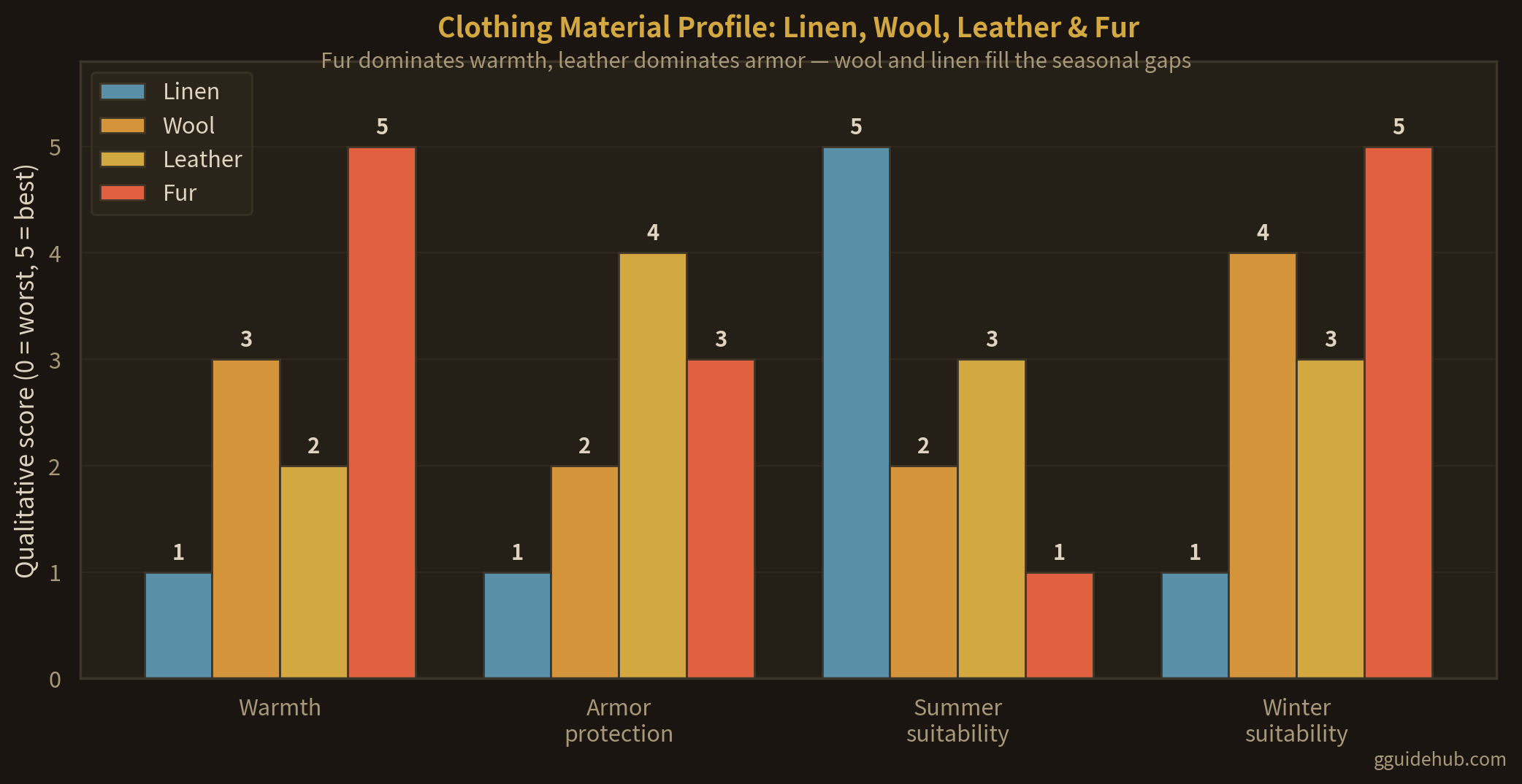
| Linen (cloth) | Low | Very low | Flax → loom → tailor bench | Summer |
| Wool | Medium-high | Low | Sheep → loom → tailor bench | Winter / shoulder seasons |
| Leather | Medium | High | Hunt or slaughter → tanning rack → tailor bench | All-year (combat pick) |
| Fur | Highest | Medium | Hunt predators / large game → tanning rack → tailor bench | Deep winter |
Fur outperforms every other material for raw warmth, which is why fur pieces are the bottleneck item for surviving the deepest freezes. Leather is the inverse pick — it gives the best protection per slot but only middling warmth, making it the combat settler’s default. Wool is the workhorse mid-tier option that covers both shoulder seasons without specialising.
Slots, Layers & What Goes Where
The clothing system is layered, not flat. Going Medieval groups worn items into a small number of slot categories — Head, Outer, Middle (the layer against the skin), Middle (the layer worn over the skin layer), and Feet — plus Hands for gloves. Two pieces can coexist on the Middle tier: an inner tunic against the skin and a piece of light armour over it. The Outer slot is single-occupancy, so a settler cannot wear a winter coat and plate armour at the same time.
| Slot | Common Items | Insulation Role |
|---|---|---|
| Head | Cloth cap, wool hat, fur hood | Covers a body part that bleeds heat fast in winter |
| Outer (over everything) | Winter coat, noble robes, plate armour | Single big-warmth or single big-cooling slot; choose one |
| Middle — skin layer | Cloth tunic, cloth pants | Base layer; linen here is fine for indoor / summer workers |
| Middle — over skin | Leather tunic, chainmail, wool jacket | Where the bulk of torso warmth and protection stacks |
| Feet | Cloth wraps, leather boots, fur boots | Often the coldest body part outdoors; do not skip |
| Hands | Cloth gloves, leather gloves | Smaller contribution than torso, but free warmth when it is cold |
Because the Outer slot is exclusive, every outdoor cold-weather outfit has to make a choice: warmth (winter coat) or protection (plate armour). Most colonies solve this with role separation — combat guards wear the armour, everyone else wears the coat.
Seasonal Outfit Recipes
Deep Winter Loadout (outdoor workers)
Fur hood on the head, fur or wool winter coat in the Outer slot, wool tunic on the skin layer, wool or leather tunic on the over-skin layer, wool or leather pants, fur boots. This is the outfit that lets a hunter, woodcutter, or wall-duty guard keep working through the coldest nights. The fur coat is the load-bearing piece; everything else is reinforcement.
Mild Winter / Shoulder Season Loadout
Wool hat, wool tunic on the skin layer, leather tunic over it, wool or leather pants, leather boots. Skip the fur coat for settlers who only spend short bursts outside. Indoors with a heated room this is already comfortable; outdoors it stretches the warm half of the calendar year without burning through fur stockpiles.
Summer Loadout (outdoor workers)
Cloth cap or bare head, cloth tunic against the skin, no Outer-layer piece, cloth pants, leather or cloth footwear. Linen breathes and is the right default when the felt temperature is climbing. Keep a wool change of clothes at the stockpile so you can swap fast when the season flips.
Combat Loadout (any season)
Leather or fur hat on the head, plate armour in the Outer slot, cloth tunic on the skin layer, chainmail over it, leather pants, leather boots. Plate armour actively cools the wearer, which is a feature in summer and a bug in winter — pair it with an extra fur layer underneath when guards go on winter wall duty.
Practical Strategy Notes
Stockpile seasonal sets, not loose pieces. A complete winter outfit per outdoor worker is easier to swap than hunting for a matching pair of wool pants at the start of every cold snap. A finished-clothing stockpile next to the tailor bench makes the swap fast.
Prioritise fur for outdoor workers first. Indoor crafters, cooks, and storeroom workers do not need a fur coat if their building is heated; the same fur coat on a hunter who spends ten hours outside is the difference between a productive day and a hypothermia death.
Quality matters at the tailor bench. Higher-quality garments give more insulation and more armor per slot than the same item at lower quality, so dedicating your best tailor to the winter-coat queue is a real payoff rather than flavour.
Do not let anyone run naked. An undressed settler has zero insulation, picks up a mood penalty, and will die in winter within a day or two outdoors. The cheapest insurance policy in the game is a cloth tunic on every colonist by the end of the first week.
FAQ
Which material is the warmest in Going Medieval?
Fur is the warmest clothing material in the game. Garments made from fur outperform wool, leather, and linen on every insulating slot, which is why fur pieces are the bottleneck for surviving deep-winter blizzards. Fur is harvested by hunting wildlife and then run through a tanning rack.
Do settlers need different clothes in summer and winter?
Yes. The same outfit that keeps a settler comfortable in winter will give them heatstroke in summer. Linen cloth pieces are the right default for warm weather because they breathe and shed warmth, while fur and wool pieces should be stored and swapped back in once temperatures drop. A finished-clothing stockpile next to the tailor bench makes the seasonal swap quick.
Can a settler wear a winter coat and plate armour at the same time?
No. The Outer slot only holds one piece at a time, so a winter coat and plate armour compete for the same slot and your settler can only equip one. Most colonies split roles — combat guards wear plate armour and accept the cooling effect, while every other colonist wears the warm coat in winter.
Which body part matters most for staying warm?
Insulation is tracked per body part, so leaving any single part bare is a real weakness — a settler in a full fur outfit with a bare head still loses a lot of heat through the head in deep winter. The most overlooked slot in practice is Feet: thin footwear on an outdoor worker in a cold snap is a frequent cause of slow hypothermia.
Does clothing quality change insulation?
Higher-quality garments produced by a skilled tailor carry more insulation and more armor per slot than the same item at a lower quality tier. The difference is noticeable but not extreme, so the bigger payoff is keeping your best tailor assigned to the cold-weather garment queue rather than spreading them across every workbench.
Related Guides
Last updated: July 22, 2026