Going Medieval Wound Care & Herbal Medicine: Keep Every Settler Alive
Araid ends, the last bandit flees, and then the real damage report arrives: the "Settler wounds need tending" notification. Going Medieval's health system is quietly one of its deepest mechanics — wounds have severity levels, tending has quality levels, supplies multiply the results, and the jobs behind it all (Tend, Patient, Convalesce) interact in ways the game never explains. Most colonies do not lose settlers to raids; they lose them to confusion afterwards. This guide covers how wounds actually heal, which supplies are worth stocking, and the exact job setup that turns a post-raid panic into a routine.
How Wounds Actually Work
Every injury in Going Medieval is a wound with a severity value that ticks down over time. While a wound is active it penalises the settler — reduced movement speed, weaker combat performance, worse hit chance, impaired motor function — so an untreated injury is never free, even when it is not lethal. Wounds fall into three behaviour categories, and knowing which one you are looking at tells you exactly how to respond.
| Wound Category | Typical Examples | Needs Tending? | Needs Bed Rest? | How It Resolves |
|---|---|---|---|---|
| Minor knocks | Bruises and similar light injuries | No — cannot be tended | No | Fades on its own with time |
| Moderate wounds | Scratches and light cuts | Yes | No — settler can keep working | Tending speeds recovery; bed rest optional |
| Severe wounds | Broken bones, deep combat injuries | Yes | Yes — days of rest | Requires active tending plus rest; after roughly 90% healed it hits the minimum severity threshold and finishes on its own with only minor lingering effects |
Key Insight: The minimum severity threshold is your discharge date. A settler with a broken leg does not need to lie in bed until the wound vanishes — once it is about 90% healed it stops requiring tending or rest, and the settler can return to light duty with only a small penalty while it finishes closing. Pulling healers off nearly-recovered patients is correct play, not neglect.
The Four Jobs Behind Every Recovery
Healing is not one job but four, split between the healer and the patient. Getting all four right is the difference between a colony that shrugs off raids and one that slowly bleeds population.
| Job | Who Does It | What It Does | Recommended Setup |
|---|---|---|---|
| Tend | Your healers | Treat wounded settlers. Tend quality scales with the settler's Medicine skill, and tending grants Medicine XP — the same people should do it every time | High priority for your best one or two Medicine settlers; enabled for everyone as a low-priority backup |
| Patient | The wounded | Sends the settler to a bed to wait for treatment without fully shutting them down | High priority for anyone with a severe wound |
| Convalesce | The wounded | Full rest-and-recover behaviour — the settler drops other work to heal | High priority for severe wounds; lower it for scratches so settlers keep working |
| Carry wounded | Everyone nearby | Hauls unconscious settlers to a free bed. Fires automatically, even for settlers without Tend enabled and outside work hours | Nothing to configure — just make sure a spare bed exists before the raid, not after |
One modern convenience worth knowing: wounds can be tended anywhere. A healer can treat a hunter in the field without dragging them home first — bed rest still matters for the severe category, but the old requirement that a patient be sleeping before anyone could help them is gone.
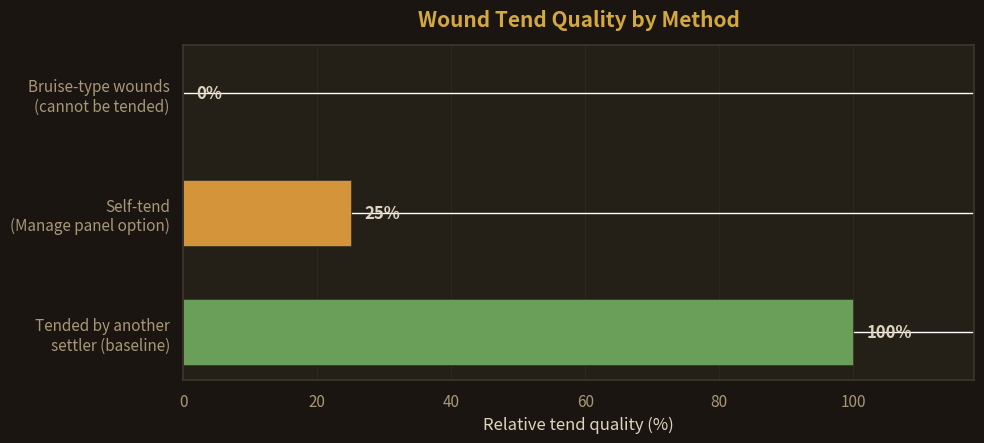
Self-Tend — The Emergency Valve:In the Manage panel you can allow a settler to treat their own wounds. It is strictly a fallback: a self-tend lands at only 25% of the quality of a tend from another settler, earns less XP, and switches off entirely if you disable that settler's Tend job. Enable it for settlers who work alone far from base; never treat it as a substitute for a real healer.
Healing Supplies: Herbs, Tallow, Honey, Healing Kits
Tending works bare-handed, but supplies make it better. Going Medieval recognises four healing items, and each carries a wound tending multiplier that improves the quality of any tend it is used in. The practical hierarchy is simple: herbs are your everyday supply, healing kits are the dedicated tool, and tallow and honey are useful stand-ins already sitting in your pantry.
| Supply | What It Is | Carried in a Pouch? | Notes |
|---|---|---|---|
| Herbs | Gathered medicinal plants | No — fetched from storage | The workhorse supply. Wild herbs grow on every map; stockpile them near the hospital so healers never walk far |
| Healing Kit | Purpose-made medical kit | Yes — the only supply settlers carry on their person | The dedicated tending tool. Because settlers keep kits in a pouch, they can treat casualties on the spot instead of running to a stockpile first |
| Tallow | Rendered animal fat | No | A by-product of butchering that doubles as a tending supply — your hunters quietly keep the infirmary stocked |
| Honey | Food with medicinal use | No | Dual-purpose: a long-lasting food that also serves as a healing supply. Buy it from merchants when other stocks run low |
Post-Raid Triage: The First Ten Minutes
The minutes after a raid decide whether wounds become footnotes or funerals. Run the same sequence every time and it becomes automatic.
| Step | Action | Why It Matters |
|---|---|---|
| 1 | Click the "Settler wounds need tending" notification to cycle through every casualty | Wounded settlers do not announce themselves individually; the notification is your headcount |
| 2 | Check for unconscious settlers first — they are being carried to beds automatically | Unconscious colonists cannot eat or move; their recovery starts only once they reach a bed |
| 3 | Set severe cases to Patient + Convalesce at high priority; leave scratches on normal duties | Over-resting minor wounds costs you a workday; under-resting a fracture costs you a settler |
| 4 | Confirm your highest-Medicine settler has Tend at top priority and supplies in reach | Tend quality scales with Medicine skill, and supplies multiply the result — skill plus herbs is the fastest legal recovery in the game |
| 5 | Restock the infirmary: herbs, kits, and a spare meal supply near the beds | Patients leave bed when hungry; a nearby food stockpile gets them back under care faster |
Building a Medical Program That Scales
Early on, one settler with a passing interest in Medicine is enough. As the colony grows toward a dozen people and raids escalate, formalise it. Keep two settlers developing the Medicine skill so an injured healer never leaves the colony untreated — a Researcher-Healer pairing works well, since both are indoor intellectual jobs and the same settler can work the research bench in peacetime and the infirmary after battles. Stockpile herbs within a few tiles of the beds, issue healing kits to your front-line fighters so the first tend happens where they fall, and buy honey or kits from merchant caravans whenever your own stocks dip.
Skip the fantasy remedies. There are no splints, antidotes, or medicinal teas in Going Medieval — recovery is always time plus tend quality, multiplied by supplies. Master those three levers and the health system stops being a threat and becomes what it should be: a routine.
Frequently Asked Questions
Do I need medicine items to heal settlers in Going Medieval?
No. Any settler with the Tend job enabled can treat wounds with empty hands, and wounds also lose severity naturally over time. What supplies add is a wound tending multiplier: herbs, tallow, honey, and healing kits each improve the quality of a tend when the healer uses them, so stocked colonies simply heal faster and more reliably.
Is self-tending worth enabling?
Only as an emergency fallback. Self-tending is switched on per settler in the Manage panel, and the quality of a self-tend is just 25% of what another settler would achieve, with less skill XP earned on top. It also requires the Tend job to stay enabled for that settler. Use it for isolated workers like hunters, but rely on a dedicated healer for anything serious.
Why did my settler's wound stop needing treatment at low severity?
That is the minimum severity threshold working as intended. Serious wounds need active tending and rest through the worst of their recovery, but once a wound is roughly 90% healed it drops to a minimum severity level: the settler no longer needs bed rest or tending, keeps only minor lingering effects like slightly reduced walk speed, and the wound finishes healing on its own.
How do I save an unconscious settler?
You do not need to micromanage it. Unconscious settlers cannot walk, so other settlers will automatically carry them to a free bed — this carry-wounded behaviour fires even for settlers without the Tend job enabled, and even outside work hours. Once the casualty is in a bed, your healers take over with normal tending.
Do bruises and minor scrapes need a healer?
No. The lightest wound category — bruises and similar knocks — cannot be tended at all and simply heals with time. The middle category, such as scratches, benefits from tending but does not force the settler into bed, so they can keep working while it closes. Reserve bed rest and your best healer for the severe category, like broken bones.
Related Guides
- Wounded Settler Healing — the recovery process in more detail
- Settler Death Prevention — keeping your colony off the casualty list
- Disease & Plague Guide — the other half of colony health
- Settler Skills — where Medicine fits in the skill system
- Winter Survival — cold is a health problem too
- Raid Defense Strategy — the best wound is the one nobody gets
Last updated: July 19, 2026. Healing mechanics reflect the current release version of Going Medieval; exact recovery speeds vary with Medicine skill and supplies.