Going Medieval Map Types Compared: Valley, Hillside, or Mountain?
Every new colony in Going Medieval starts with the same deceptively simple choice on the setup screen: Valley, Hillside, or Mountain. These three map types are the only terrain options in the game, and the one you pick shapes everything that follows — how much flat ground you have for a castle, how far your farmers walk to fertile soil, how quickly your miners hit iron, and how many directions a raid can come from. There is no wrong answer, but there is a wrong answer for your playstyle. This guide compares all three map types on the factors that actually matter, then covers seeds, map size, and starting conditions so you can make the choice with full information instead of regenerating five times and hoping.
The Three Map Types at a Glance
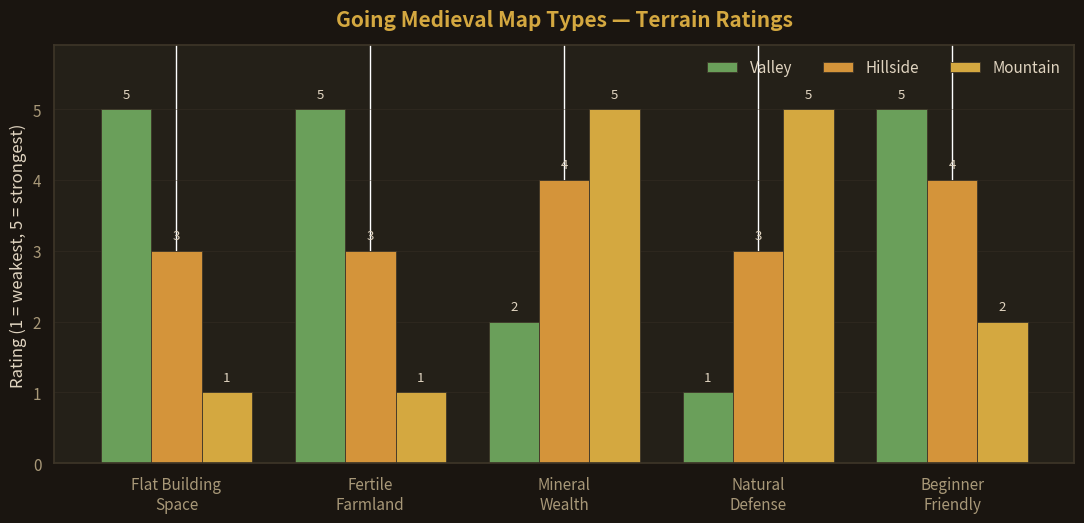
All three map types share the same temperate climate, the same four-season cycle, and the same pool of surface life — trees for wood, berry bushes, and wild animals to hunt. What separates them is terrain shape and resource distribution. Valley trades safety for comfort, Mountain trades comfort for safety, and Hillside sits deliberately in between.
| Factor | Valley | Hillside | Mountain |
|---|---|---|---|
| Terrain | Broad flat lowland | Rolling hills, ridges, canyons | Steep peaks, cliffs, small plateaus |
| Flat building space | Abundant | Moderate, broken into pockets | Scarce — expect to terrace or dig in |
| Fertile farmland | Largest continuous stretches | Decent patches between slopes | Small, scattered pockets |
| Near-surface iron & ore | Often scarce or deep-buried | Frequently rich and close | Abundant, exposed in rock faces |
| Stone for construction | Must be mined underground | Good access | Effectively unlimited |
| Natural defense | None — open on every side | Partial — high ground and funnels | Excellent — one or two approach angles |
| Best for | Beginners, megabases, farming | Balanced play, all-rounders | Defense-first, industry, veterans |
Key Insight:No map type is "harder" because of weather — the seasons are identical everywhere. Difficulty comes from two things: how early you can reach iron, and how many directions you must defend. A Valley colony eats well but fights on open ground; a Mountain colony barely fights at all but scrambles for food. Pick the problem you would rather have.
Valley — The Farming Powerhouse
Valley maps are wide, flat lowland: the most buildable terrain in the game. Continuous stretches of fertile soil let you lay out huge fields in any shape you want, and clay deposits for brickmaking are commonly found close to the surface. If your goal is a sprawling walled town with symmetrical districts, Valley is the only map type where the terrain never fights your floor plan.
The weaknesses are real, though. Iron can be scarce or buried deep enough that your first metal tools arrive late, and stone for construction has to be mined rather than gathered from exposed rock. More importantly, the map is open on every side — raiders walk in from any compass direction, so a perimeter wall is not optional, it is a first-season project. Budget the wood and labour for a full palisade early, and plan a killbox on the busiest approach.
Hillside — The Balanced All-Rounder
Hillside maps roll: ridges, knolls, and canyons break the terrain into pockets of flat ground separated by slopes. It is the most resource-balanced of the three types — community-documented Hillside seeds are frequently rich in near-surface iron, with clay, coal, and even silver appearing in the same hillsides. Fertile soil shows up in usable patches rather than endless fields, which nudges you toward several mid-sized farms instead of one mega-field.
Defensively, Hillside rewards players who read terrain. A colony built on a plateau with steep slopes on two or three sides only needs walls on the gaps, and elevated ground gives your archers the height advantage that extends their effective range. If you have played a map or two and want a colony that can pivot between farming, mining, and military without the terrain locking you in, Hillside is the pick.
Mountain — The Natural Fortress
Mountain maps are dominated by steep peaks and cliff faces, with limited flat land between them. That scarcity is the point: rock is effectively unlimited, ore is exposed in the mountainsides, and the terrain itself does most of your defensive work. Many Mountain seeds funnel all raider traffic through one or two valleys or passes, which means a single short wall line and one well-built killbox can hold off raids that would flatten an open colony. Digging rooms straight into the rock also gives you naturally insulated storage that stays cold deep underground — a genuine advantage for food preservation.
The price is food. Flat, fertile pockets are small and scattered, so crop farming alone rarely carries a Mountain colony through winter. Successful Mountain runs lean on hunting, animal husbandry, preserved rations, and trading surplus metal goods to merchant caravans for bulk food. Pick Mountain when defense and industry are the fantasy you want, and you are comfortable solving the food problem with something other than wheat fields.
Seeds, Map Size, and Starting Conditions
The map type is only one of several levers on the new-game screen. The rest are easy to overlook and just as important to how the first year plays out.
| Setting | Options | What It Actually Changes |
|---|---|---|
| Map type | Valley / Hillside / Mountain | Terrain shape and resource distribution — the subject of this guide |
| Map size | Small through Large | Bigger maps mean more total resources and elbow room, but longer walking distances — settlers burn work hours travelling, so do not default to Large for a small colony |
| Seed | Any letters or numbers | The exact layout. The same seed regenerates the same map within the same game version, which is how players share finds; major updates can change the generation algorithm and alter results |
| Starting conditions | A New Life / Lone Wolf | A New Life starts you with three settlers and a stock of supplies; Lone Wolf drops a single settler on the map for a much harder opening |
| Difficulty | Presets (e.g. Normal) plus custom raid settings | Raid size, frequency, and scaling. Terrain difficulty from your map type stacks on top of this |
Community-Favourite Seeds by Map Type
Because seeds are shareable, the community has spent years cataloguing good ones. These documented examples show what each map type can produce at its best — note that seeds are version-specific, so a seed shared from an older build may generate differently after a map-generation update.
| Seed | Map Type | What Makes It Notable |
|---|---|---|
| 12345 | Valley | Extremely flat middle ground with large clay deposits — a builder's dream, but iron is absent near the surface |
| 777 | Hillside | A high hill in the corner of the map with a large flat top — a ready-made fortress plateau |
| 679130838 | Hillside | Rich in resources, especially iron, with dramatic topography of hills and canyons |
| b | Hillside | One giant hill carrying iron, clay, coal, and silver — yes, a single letter is a valid seed |
| 1278876402 | Mountain | A wide central hill ideal for building, backed by larger mountains in the corners |
| 1562457994 | Mountain | Very high mountains ringing a sheltered central valley — one natural entrance to defend |
The Verdict: Match the Map to the Colony You Want
Pick Valley if this is your first colony or your dream is a huge symmetrical castle town. You will eat well from day one, and the wall-building workload is a fair price for it. Pick Hillside if you want options — it is the only map type where farming, mining, and defense are all genuinely viable at once, which is why so many shared seeds come from Hillside generation. Pick Mountain when raids are the problem you want solved and food is the puzzle you find fun: nothing else in the game lets a ten-settler colony shrug off late-game sieges the way a one-entrance Mountain holdfast does.
Whichever you choose, commit before you invest in permanent structures — relocating a colony is not a thing in Going Medieval. If you want to browse more pre-vetted starts before deciding, our best map seeds list keeps an updated shortlist for the current version.
Frequently Asked Questions
Which map type should a beginner pick in Going Medieval?
Valley. It gives the largest continuous flat areas, the widest stretches of fertile soil for farming, and the simplest base layouts, so food production comes online fast. The trade-off is defense: raiders can walk in from any direction, so budget wood and labour for a perimeter palisade earlier than you would on other map types.
Does the map type change the weather or seasons?
No. All three map types share the same temperate climate with the same four-season cycle, winter freezes, and heat waves. What changes between Valley, Hillside, and Mountain is the shape of the terrain and how resources are distributed — not the weather you will face.
Do map seeds still work after game updates?
A seed always regenerates the same map within the same game version, and the seed field accepts both letters and numbers. However, the map generation algorithm has changed between major versions, so a seed shared from an older version may produce a different layout in the current build. Treat community seed lists as version-specific.
Can I still get iron on a Valley map?
Yes, but expect to work for it. Valley maps can generate with few or no near-surface iron deposits, so you may need to dig deep mine shafts to reach ore veins. Hillside and Mountain maps expose metal far more readily. On a metal-poor Valley seed, cover the gap by trading with merchant caravans and melting down raider equipment.
Which map type is best for defense?
Mountain, by a wide margin. Steep slopes and cliffs cut the number of approach angles down to one or two, which means a single short wall line and one killbox can cover the whole colony. Hillside is a solid second — high ground for archers and partial natural funnels — while Valley offers no natural protection at all and must be fully walled.
Related Guides
- Best Map Seeds — pre-vetted starts for every playstyle
- Iron Mining — finding and extracting ore on any map type
- Killbox Design — turn your one good approach into a meat grinder
- Defense Strategy — perimeter planning for open and fortified terrain
- Farming Fundamentals — making the most of your soil, wherever it is
- Beginner's Guide — your first season, step by step
Last updated: July 19, 2026. Map type behaviour reflects the current release version of Going Medieval; shared seeds are version-specific and may generate differently after map-generation updates.