Going Medieval Farming Calendar
A Going Medieval year is a conveyor belt: spring sows, summer doubles, autumn cashes out, and winter — 12 cold days when nothing grows — audits your work. The crops themselves are simple; the calendar is the game. Cabbage needs 5 days to full yield, carrot 7, beet 9, barley 14, and every one of those countdowns has to fit between thaw and frost. This calendar lays out the whole year: what goes in the ground when, how many tiles each settler actually needs, and where the deadlines hide.
Crop Timing Reference
These are the numbers the calendar is built from — days to full yield under normal temperatures and base yield at peak per tile. Cold snaps slow growth, heatwaves stress it, and barley cannot be sown below 5°C at all. Full analysis of each crop's role lives in our best crops per season guide; this page is about when, not which.
| Crop | Days to Full Yield | Yield at Peak | Yield per Day | Sowing Window |
|---|---|---|---|---|
| Tall Grass | 4 | 30 | 7.50 | Spring, day one — fodder and bedding first |
| Cabbage | 5 | 9 | 1.80 | Spring through late autumn — the only safe late sowing |
| Carrot | 7 | 14 | 2.00 | Spring and summer; nothing after mid-autumn |
| Flax | 8 | 11 | 1.38 | Spring, once food is stable — clothing comes second |
| Herbs | 8 | 6 | 0.75 | Spring; one small plot is enough for medicine and cooking |
| Beet | 9 | 15 | 1.67 | Spring and summer; mid-autumn deadline |
| Barley | 14 | 8 (+25 hay) | 0.57 | Early spring only — needs the full warm window; cannot be sown below 5°C |
| Redcurrant | 15 (first crop) | 12 | 0.80 | Spring — 5 harvests per planting repay the wait |
The Farming Year at a Glance
The whole calendar in one picture: sowing waves in spring and summer, the autumn cash-out with its frost deadline, and the 12-day winter where the fields lie fallow and the cellar does the farming.
How Many Tiles per Settler?
The calendar needs a size. Settlers eat one meal a day and a meal costs 12 raw food, so each settler consumes 12 raw food daily. Divide that by each crop's yield per day and you get the field size that keeps one settler fed indefinitely:
| Crop | Yield per Day per Tile | Tiles per Settler (12 food/day) | Calendar Role |
|---|---|---|---|
| Carrot | 2.00 | 6 | Most tile-efficient food; the backbone of the plan |
| Cabbage | 1.80 | ~7 | Fastest cycle; best spring starter and autumn gap-filler |
| Beet | 1.67 | ~7 | Highest yield per tile; best for storage-focused fields |
| Barley | 0.57 | ~21 | Never a food crop — grow only what the brewery needs |
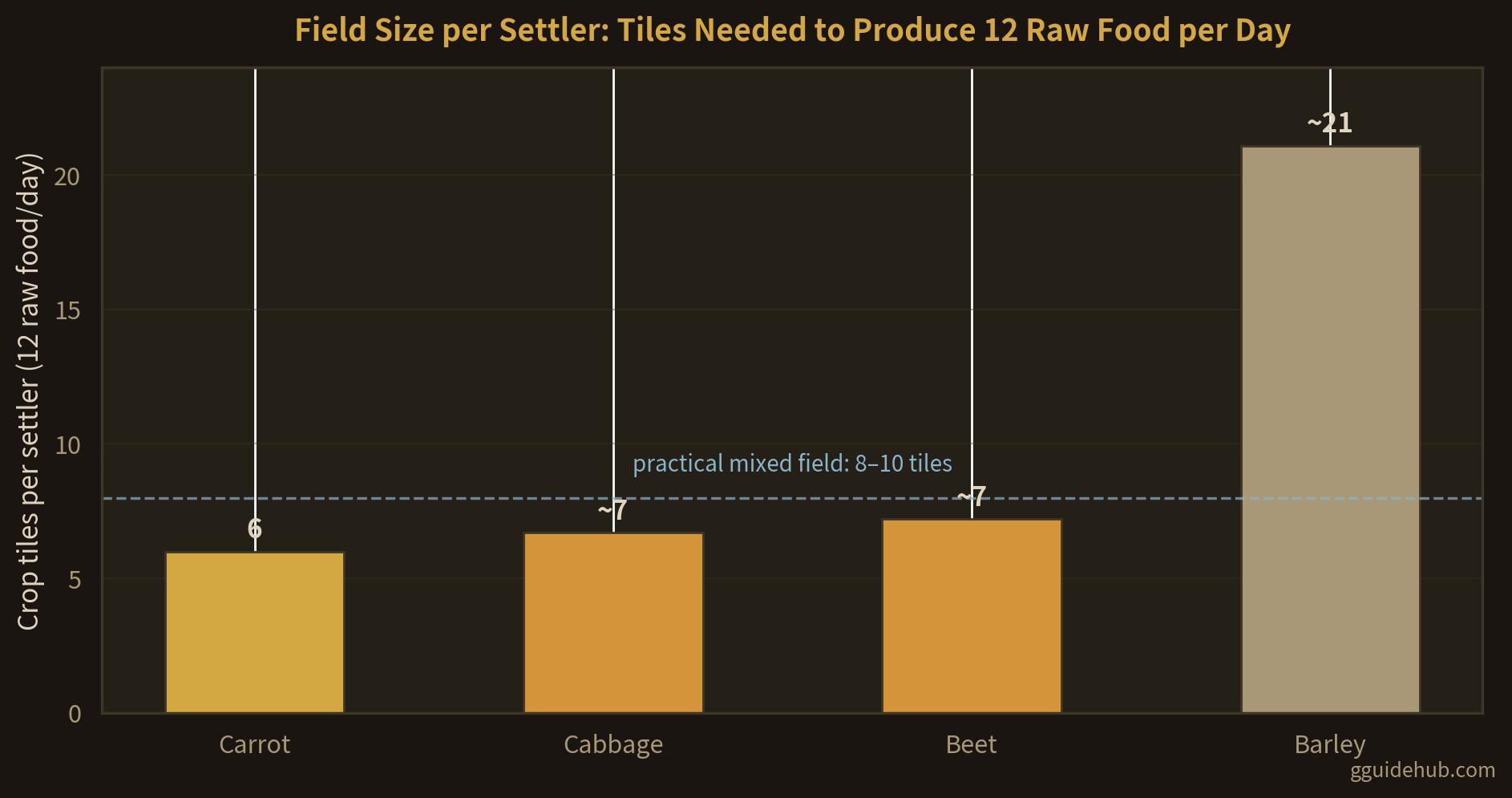
In practice, plant a mixed 8–10 food tiles per settler — the mix hedges against a cold snap or heatwave hitting a single crop at a vulnerable stage — then add flax, a small herb plot, and brewing barley on top. And stagger everything: sow batches two to three days apart so each harvest wave is small enough to clear before the next one ripens. A field that ripens all at once rots all at once when life interrupts.
The Season-by-Season Schedule
| Season | Sow | Harvest / Other Work | Deadline |
|---|---|---|---|
| Spring | Tall grass and cabbage day one; carrot and beet within days; barley and redcurrant early; flax and herbs once food is stable | First cabbage at ~day 5; tall grass at ~day 4; expand fields as labour allows | Barley must go in early — 14 days plus a possible cold snap needs the full warm runway |
| Summer | Second cycles of cabbage, carrot, beet as the spring sowings come out | Continuous rolling harvest; haul everything underground the day it comes in — summer heat rots surface stockpiles fast | During heatwaves, prioritise ripe fields; wilted or heat-stressed crops lose time |
| Autumn | Final cabbage cycle; carrot and beet only before mid-autumn | The cash-out: everything to the cellar, surplus to the pickling stove, hunts to the smokehouse — target 12+ meals per settler stored | First frost kills unharvested crops; when in doubt, harvest early |
| Winter (12 days) | Nothing — crops stop growing in the cold | Hunting, smoking, hauling, construction, and next year's field plan; open the cellar to freeze it | Have fields zoned and seeds of plan ready for the first thaw day |
The autumn row is where colonies are won or lost. Winter lasts 12 days, so the storage target is at least 12 meals — 144 raw food — per settler in stable form before the frost. Run the exact numbers in our winter food storage guide, build the cellar to hold them with the food preservation guide, and keep soil quality up year over year with crop rotation and soil fertility management.
Frequently Asked Questions
What should I plant on day one of spring in Going Medieval?
Cabbage and tall grass immediately. Cabbage reaches full yield in about 5 days — the fastest food crop — so a day-one sowing guarantees the earliest possible first meal from your fields. Tall grass takes about 4 days and yields 30 per tile, securing bedding, thatch, and animal fodder almost at once. Follow with carrot and beet within the first few days, and barley early only if you brew, since its 14-day cycle needs the full warm window.
When is the last safe sowing before winter in Going Medieval?
Count backwards from the first frost using each crop's days to full yield. Cabbage (5 days) can go in as little as a week before frost and still make it; carrot (7 days) and beet (9 days) need to be in the ground by mid-autumn; barley (14 days) and redcurrant (15 days to first crop) are spring-only propositions. When in doubt, harvest slightly early — an unharvested field dies when the frost hits.
How many crop tiles does each settler need in Going Medieval?
Settlers eat one meal a day and a meal costs 12 raw food. Dividing by yield per day per tile gives roughly 7 cabbage tiles, 6 carrot tiles, or 7 beet tiles per settler per cycle — and about 21 barley tiles if you foolishly tried to feed people on barley. In practice a mixed field of 8–10 tiles per settler, staggered in batches a few days apart, covers consumption with room for spoilage.
How long is winter in Going Medieval and how do I farm around it?
Winter lasts 12 days, and outdoor crops stop growing in the cold. You don't farm during winter — you farm for it. The calendar goal is to have every tile harvested before the first frost and at least 12 meals (144 raw food) per settler in the cellar, then spend the 12 winter days on hunting, smoking meat, hauling, and planning next year's layout.
Should I stagger my sowing in Going Medieval?
Yes — staggered sowing is the single biggest farming quality-of-life habit. Every tile sown must be harvested within its ripe window, and a full field sown on one day ripens on one day, spiking labour exactly when other work piles up. Sow in batches two to three days apart so harvests (and hauling) arrive in waves you can actually clear, and so a single cold snap or heatwave never hits your entire crop at the same growth stage.
Related Guides
- Best Crops for Each Season — the companion crop-selection guide
- Winter Food Storage — cellar temps and winter food math
- Food Preservation — turn the autumn harvest into stable stores
- Crop Rotation Guide — keep the calendar productive long-term
- Soil Fertility — more yield from the same tiles
- Brewery Guide — what your barley is actually for
- Seasons — weather events, temperature swings, and effects
Last updated: July 19, 2026. Exact season lengths beyond winter vary by map, so deadlines are given relative to the first frost.