Going Medieval Winter Food Storage
Winter in Going Medieval is a logistics exam you sit in autumn. Crops stop growing, hunting gets thin, and the colony eats through whatever you managed to put away — and whatever you stored badly rots before it is eaten. The fix is part architecture, part arithmetic: dig a cold cellar that actually stays cold (a properly finished one holds around 2°C even in a 32°C summer), and store enough raw food for the 12-day winter — 12 meals per settler at minimum. This guide covers the real temperatures each construction choice buys you, then the food math that tells you whether you are ready.
Cold Storage Temperatures: What Each Upgrade Buys
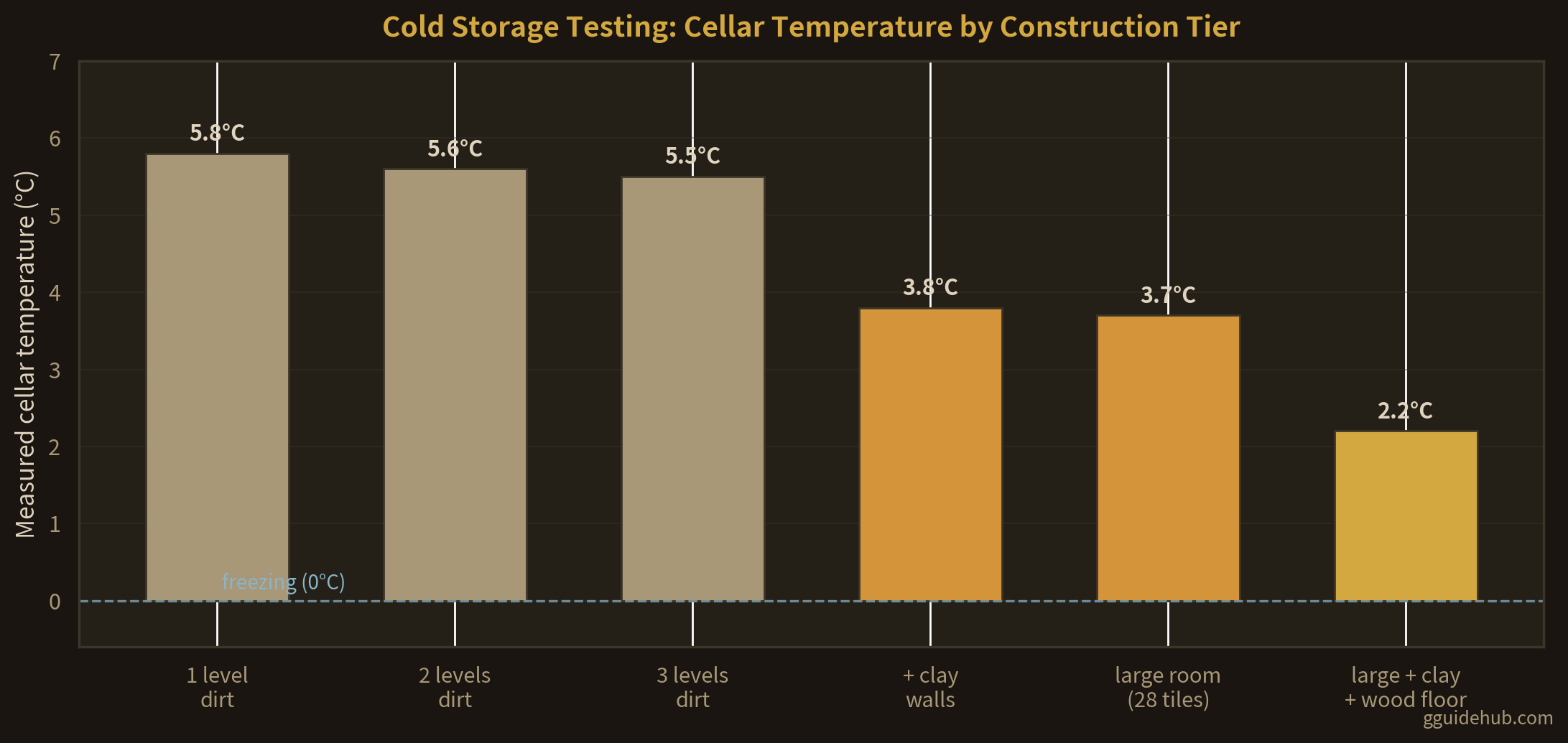
Food decay in Going Medieval is temperature-driven: the warmer the room, the faster freshness ticks down. Cold storage testing measured a series of cellar builds on the same map, and the results overturn the common instinct to just dig deeper. Depth gives diminishing tenths of a degree; construction gives whole degrees.
| Cellar Build | Measured Temperature | Gain vs. Previous Tier | Verdict |
|---|---|---|---|
| 1 level of dirt overhead | 5.8°C | — | The day-one dig; better than any surface room |
| 2 levels of dirt overhead | 5.6°C | -0.2°C | Not worth the extra digging early |
| 3 levels of dirt overhead | 5.5°C | -0.1°C | Diminishing returns confirmed |
| Clay walls added (3×3 room) | 3.8°C | -1.7°C | The single biggest upgrade — built walls insulate far better than bare dirt |
| Larger room (28 free tiles) | 3.7°C | -0.1°C | Small rooms trap heat; size helps modestly |
| Large room + clay walls + wood floor | 2.2°C | -1.5°C | Best-in-test; held ~2°C during a 32°C summer |
Two material notes from the same testing. First, flooring now acts as insulation, not a heat source, so you can floor your cellar safely — wood flooring even nudged the room slightly colder. Second, bare dirt walls have a higher insulation value on paper (0.95) than clay (0.9) but deliver less real insulation in-game; a room surrounded by built walls tested about 2°C colder than the same room in raw dirt. Trust the thermometer, not the tooltip.
| Material | Thermal Insulation Value | Role in the Cellar |
|---|---|---|
| Wicker grated floor | 0.05 | Decorative; no meaningful insulation |
| Wood flooring | 0.75 | Cheap insulated floor for storage rooms |
| Limestone / clay tile floor | 0.8 | Best floor insulation found in testing |
| Clay wall | 0.9 | Early-game cellar walls; big temperature gain |
| Dirt (natural) | 0.95 | Highest listed value, but underperforms built walls in practice |
Structural warning: Going Medieval simulates stability — a 7×7 dug-out room will cave in at the centre tile, deleting the soil (and the insulation) above it. Leave the centre tile undug or build support posts and beams in any wide cellar. And never place braziers, torches, or candles inside the storage: light the stairs, keep the larder dark.
Example Cold Cellar Layout (Cutaway View)
The pattern the testing points to: a staircase down one level, a door to keep the cold in, clay walls lining the dug-out room, an insulated floor, shelves to compress storage, and a support post before the span gets ambitious. No heat sources anywhere below the door.
Winter Food Math: 12 Days, 12 Meals per Settler
Winter lasts 12 days, and settlers eat one meal a day — so the absolute floor is 12 meals per settler. Since a meal costs 12 raw food, that is 144 raw food per settler in the cellar before the first frost. In field terms, using the peak yields from our best crops guide:
| Crop | Peak Yield per Tile | Tiles per Settler for Winter (144 food) | Notes |
|---|---|---|---|
| Cabbage | 9 | 16 | Fast (5 days) — the autumn gap-filler |
| Carrot | 14 | ~11 | Stores well; the winter staple |
| Beet | 15 | ~10 | Highest food yield per tile |
| Redcurrant | 12 × 5 harvests | ~3 (across the warm year) | No replanting; doubles as wine stock |
Treat 12 meals per settler as the floor, not the target. Add margin for three things: spoilage on the way in (food hauled across a hot map in autumn arrives partly decayed), appetite events (new settlers and prisoners eat too), and the spring gap (the first cabbage harvest is still 5 days after the soil thaws). A 25–50% buffer — call it 16–18 meals per settler — is the comfortable line. Whatever you cannot grow, hunting and a smokehouse can cover; see the food preservation guide for the full processing pipeline.
A final trick: in winter itself you can open the cellar door (or use windows) to pull the room below freezing, which all but pauses decay — and ice cut in winter can hold summer temperatures down, though ice cannot push a room below 0°C. Winter is when your cellar is cheapest to run; the build above is what carries you through summer and autumn.
Frequently Asked Questions
How cold can an underground cellar get in Going Medieval?
A finished cellar measures 5.8°C under a single level of dirt, 5.5°C under three levels, 3.8°C with clay walls added, and 2.2°C in a large room combining clay walls and wood flooring. During a 32°C summer the finished storage held around 2°C. Depth alone helps little beyond the first level — wall material, flooring, and room size matter more.
How much food do I need to survive winter in Going Medieval?
Winter lasts 12 days and settlers eat one meal a day, so you need at least 12 meals per settler. A meal costs 12 raw food, which means 144 raw food per settler stored before the frost — roughly 16 cabbage tiles, 11 carrot tiles, or 10 beet tiles per settler at peak yield, plus a buffer for spoilage, hunting failures, and new arrivals.
Does digging deeper make food storage colder in Going Medieval?
Barely. One level of dirt overhead gives 5.8°C, two levels 5.6°C, and three levels 5.5°C — diminishing returns of a few tenths of a degree per level. You get far more from adding built walls (clay walls dropped the test room to 3.8°C), insulating floors, and making the room bigger, since heat gets trapped in small rooms.
Should I put a torch or brazier in my food cellar in Going Medieval?
No. Anything that produces heat — braziers, torches, candles — warms the room and speeds up decay. Light the staircase and adjacent rooms instead, and keep the storage itself dark. Haulers spend only seconds inside, so darkness is a cosmetic issue, while every degree of warmth is real spoilage.
What foods do NOT need cold storage in Going Medieval?
Pickled vegetables — vegetables preserved in salt at a stove — do not need cold storage at all, and smoked meat from a smokehouse keeps far longer than raw meat. Converting part of your harvest into preserved goods shrinks the cellar space you need and hedges against a warm spell rotting your fresh stores.
Related Guides
- Food Preservation Guide — smoking, pickling, and the processing pipeline
- Best Crops for Each Season — grow the food this cellar stores
- Farming Calendar — schedule sowing so autumn fills the larder
- Root Cellar — detailed cellar construction walkthrough
- Winter Survival — warmth, clothing, and cold-weather labour
- Hunting Strategy — winter protein for the smokehouse
- Storage Guide — stockpile zoning beyond food
Last updated: July 19, 2026. Values may shift with game updates and difficulty settings.