Going Medieval Food Preservation Guide
Every harvest in Going Medieval starts rotting the moment it leaves the ground. Freshness ticks down constantly, heat makes it tick faster, and a summer stockpile is less a pantry than a countdown. Preservation is the art of moving food out of that countdown — into a cellar cold enough to slow it, into a smokehouse that converts fragile raw meat into stable rations, or into salt, which produces pickled vegetables that never need cold storage at all. This guide covers each method with the real numbers, then the seasonal workflow that ties them together.
The Three Preservation Methods
| Method | Station / Structure | Input → Output | Storage Requirement | Best For |
|---|---|---|---|---|
| Cold storage | Underground cellar (dig down, add walls, floor, shelves) | Any perishable → slower decay | The cellar itself; finished rooms reach ~2–4°C | Fresh vegetables, dairy, raw ingredients awaiting the kitchen |
| Smoking | Smokehouse (crafting station) | Raw meat → smoked meat | Keeps far longer than raw meat; cellar optional | Autumn hunt surplus; winter protein |
| Pickling | Stove + salt | Vegetables + salt → pickled vegetables | None — no cold storage needed | Cabbage/carrot/beet surplus; heatwave-proof stores |
The methods stack rather than compete. Cold storage is the default for everything fresh — it buys time but never stops the clock entirely. Smoking is a conversion, not a delay: raw meat is the most perishable food in the game, and smoked meat is a stable ration, so the smokehouse should run continuously whenever hunters are bringing in carcasses. Pickling is your insurance policy: salt is mined or traded for, and each batch of pickled vegetables is food that cannot be lost to a broken cellar, a heatwave, or a hauler strike. Pickled vegetables cook into stews just like fresh ones, so there is no kitchen penalty for converting your surplus.
Meals spoil too. Cooked meals are perishable items, so mass-cooking in autumn just moves the rot from the stockpile to the meal stack. Cook to demand — set meal bills with a small buffer — and keep the bulk of your winter reserves in stable form: cellar vegetables, smoked meat, pickles. Your kitchen should sit next to the cellar stairs to shorten the haul.
Cold Storage: Temperatures and Insulation, Measured
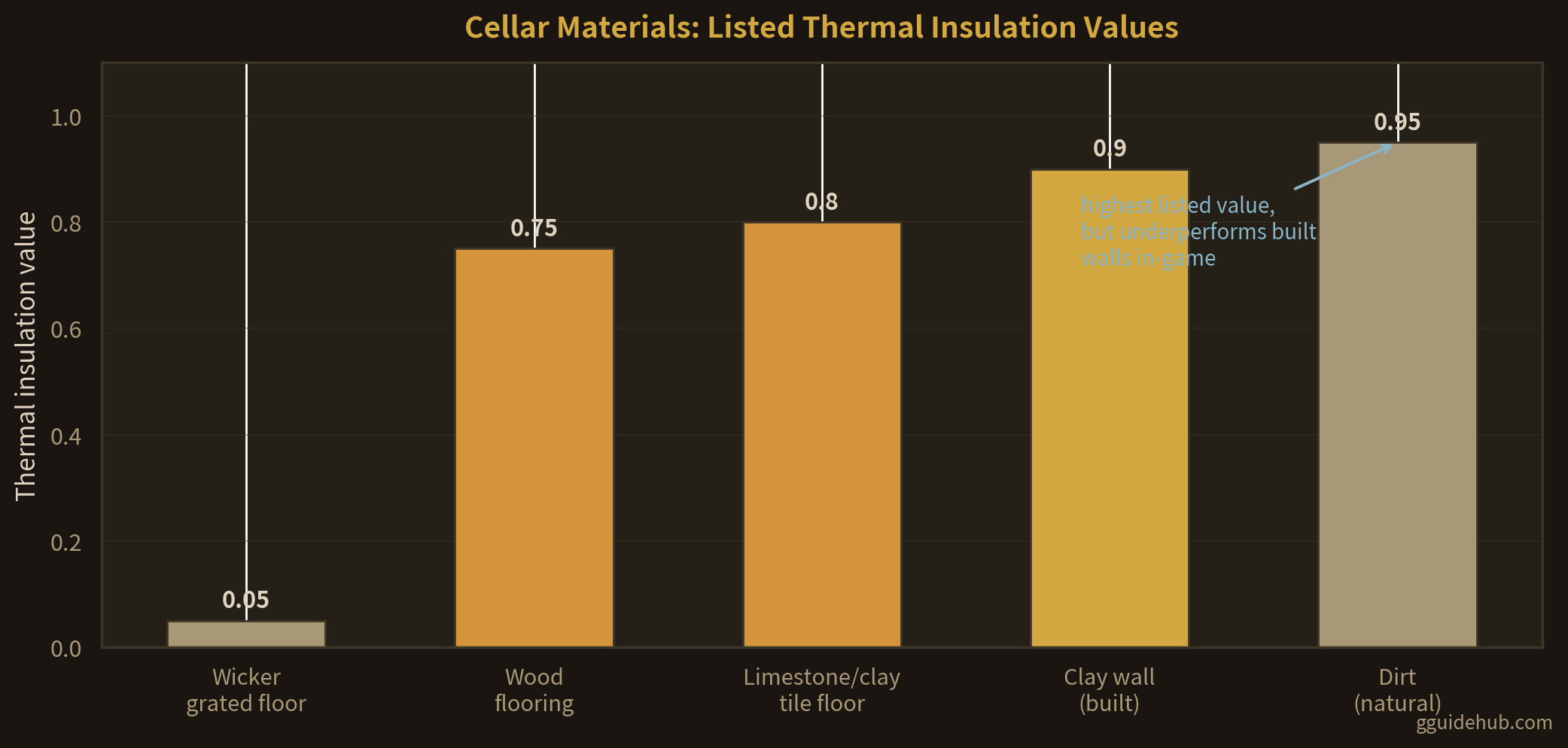
Decay speed tracks room temperature, so the quality of your cellar is a number, not a vibe. Cold storage testing measured how construction choices move that number — the short version is that walls and floors beat depth.
| Material / Choice | Thermal Insulation | Measured Effect |
|---|---|---|
| Wicker grated floor | 0.05 | Room stayed at the level default (5.5°C) |
| Wood flooring | 0.75 | Slightly colder than bare ground (5.2°C vs 5.5°C in test) |
| Limestone / clay tile floor | 0.8 | Best floor insulation identified in testing |
| Clay wall | 0.9 | Dropped a test room from ~5.5°C to 3.8°C |
| Dirt (natural walls) | 0.95 | Highest listed value, but underperforms built walls — clay-lined room was ~2°C colder than the dirt equivalent |
Combine the lessons and the ceiling is impressive: the best build — a large room, clay walls, wood floor — held 2.2°C, and stayed near 2°C through a 32°C summer. Two supporting rules: never put heat sources (braziers, torches, candles) in the room, and respect structural stability — a dug-out span wider than 7 tiles caves in without support posts. In winter, open the door or add a window to pull the room below freezing; ice cut in winter can then be used to hold summer temperatures down, though ice cannot push a room below 0°C. The full build walkthrough is in our winter food storage guide and root cellar guide.
The Seasonal Preservation Workflow
| Season | Preservation Work | Why |
|---|---|---|
| Spring | Dig the cellar; research Preserving Food for shelves; smoke whatever the hunters bring in | Early game meat spoils fastest; the cellar pays off from the first harvest onward |
| Summer | Haul harvests underground immediately; cook to demand only; keep the smokehouse running | Summer heat (30°C+) accelerates decay — surface stockpiles are the main cause of lost food |
| Autumn | Peak processing season: smoke every carcass, pickle vegetable surplus with salt, fill the cellar | Last chance to convert before winter; target 12+ meals per settler (144 raw food) in stable form |
| Winter | Open the cellar to freeze it; hunt when weather allows; ration fresh items first, preserved last | Freezing all but pauses decay; eat the countdown items before the stable ones |
The ordering principle is simple: eat down the perishability ladder. Raw meat and fresh produce first, cooked meals as made, cellar vegetables through winter, and smoked meat and pickles as the reserve that sees you into spring. Colonies starve in February not because they grew too little, but because they ate the stable food in November and watched the fresh food rot in December. Pair this workflow with the farming calendar and seasonal crop choices so the cellar fills on schedule, and keep hunters busy with our hunting strategy guide.
Frequently Asked Questions
How do you preserve food in Going Medieval?
Three ways: cold, smoke, and salt. A dug-out underground cellar slows decay for everything stored in it — a finished cellar gets down to 2.2°C. A smokehouse converts raw meat into smoked meat, which keeps far longer. And a stove with salt turns vegetables into pickled vegetables, which do not need cold storage at all. A resilient colony uses all three.
Do pickled vegetables need cold storage in Going Medieval?
No. Pickled vegetables do not need to be placed in cold storage and do not ferment. They are made at a stove from vegetables and salt, and they cook into stews exactly like fresh vegetables — so every tile of cabbage or beet you pickle is one that frees up cellar space and survives a heatwave.
What is the best way to store meat in Going Medieval?
Smoke it. Raw meat is the most fragile food in the game and rots fast even in a cellar; a smokehouse converts it into smoked meat, a stable winter ration. Hunt heavily in autumn, run the smokehouse continuously, and store the output in your cellar as a hedge on top of your vegetable harvest. Only keep raw meat you plan to cook within a day or two.
Why is my food rotting in storage in Going Medieval?
Almost always temperature. Surface stockpiles follow outdoor weather, and summer heat accelerates decay — food effectively cooks in the sun. Move perishables underground: even a basic one-level cellar sits around 5.8°C versus summer peaks above 30°C. Also check for heat sources (torches, braziers, candles) in the room, and remember cooked meals spoil too — produce meals to demand, not in bulk.
When should I start preserving food for winter in Going Medieval?
Autumn, the moment the final harvests start coming in — and the smokehouse should already be running on autumn hunts before that. Winter lasts 12 days, so the target is at least 12 meals (144 raw food) per settler in stable form: cellar-stored vegetables, smoked meat, and pickled vegetables. Preservation done in winter is too late; the raw ingredients will already be rotting or frozen in the ground.
Related Guides
- Winter Food Storage — cellar builds and winter food math
- Best Crops for Each Season — what to grow for preserving
- Farming Calendar — time harvests to the processing window
- Root Cellar — step-by-step cold storage construction
- Hunting Strategy — feed the smokehouse
- Kitchen Design — cook to demand, next to the cellar
- Brewery Guide — barley and redcurrants into ale, beer, and wine
Last updated: July 19, 2026. Exact decay rates vary with temperature events and game updates, so per-item shelf lives are described qualitatively.