Going Medieval Ice Storage — Ice Blocks and Cold Rooms
Ice is the finishing touch on Going Medieval cold storage. A dug-out cellar does most of the work, but an Ice Box lets you manufacture ice blocks that lower a room's temperature and hold it down through the warm months. The catch is timing and a hard floor: ice is produced only below freezing, so it is a winter crop, and it can cool a room toward 0°C but never below it.
How Ice Production Works
The Ice Box is a wooden workstation that holds water as it freezes and generates ice blocks for the settlement. Those blocks lower the temperature of whatever room they are placed in. Production is conditional: the Ice Box only makes ice when the air is below 0°C (32°F), it works best under open sky, and snow cuts its efficiency to 90%. In practice that makes ice a winter-only, above-ground job — dug-out underground rooms stay above freezing, so a cellar is the wrong place to run the box.
| Production Rule | Requirement | Why It Matters |
|---|---|---|
| Temperature gate | Below 0°C (32°F) | The Ice Box only produces ice when the surrounding temperature is below freezing. |
| Placement | Open sky | It works best without a roof overhead. |
| Snow | 90% efficiency | Output drops during snow instead of running at full rate. |
| Season | Winter, in practice | Underground rooms no longer fall below 0°C, so ice is made above ground during the cold months. |
Where Ice Sits in the Cooling Ladder
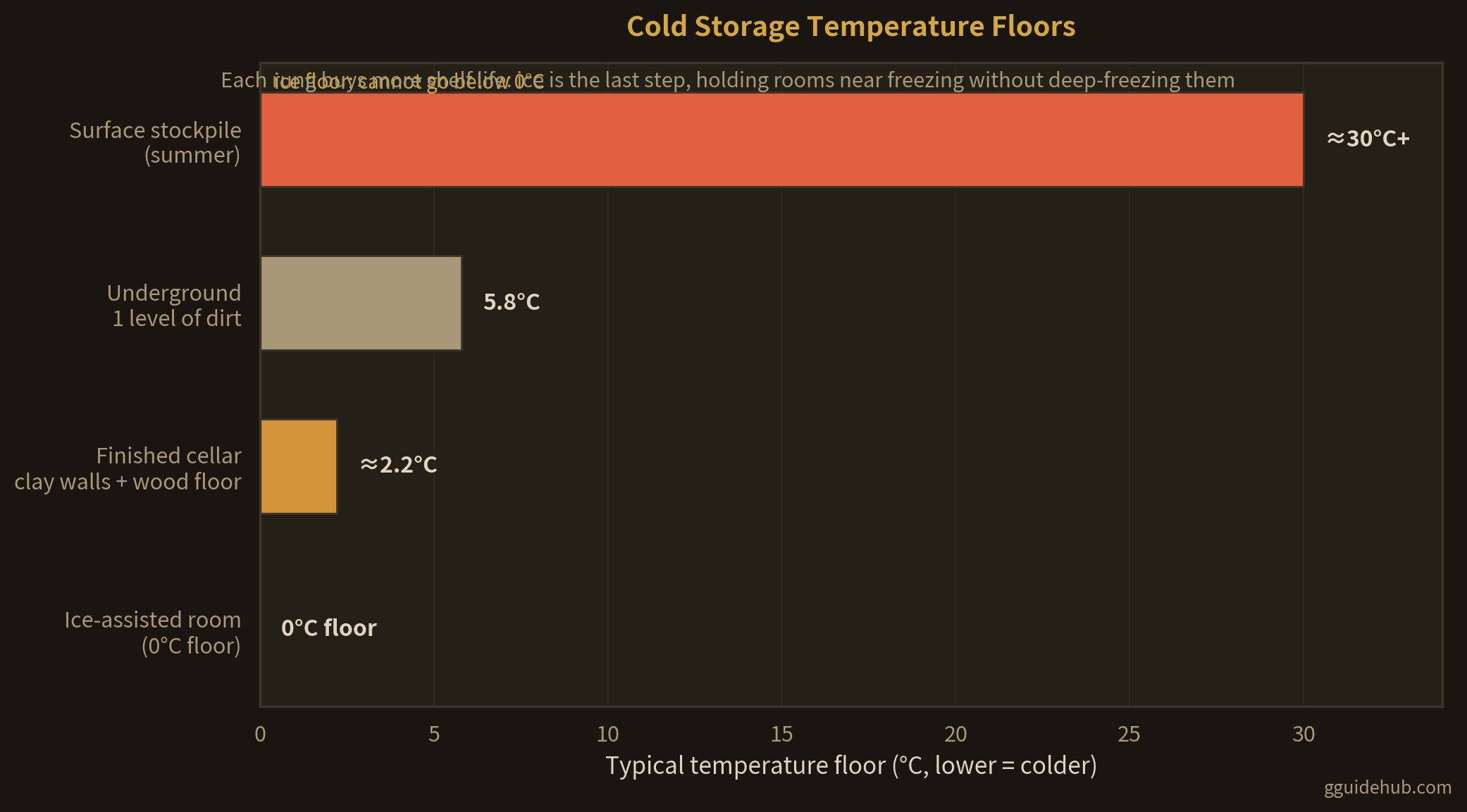
Cold storage is a series of temperature floors, and ice is the last rung. A surface stockpile bakes in summer heat, a shallow underground room gets you to roughly 6°C, and a finished cellar with built walls and an insulated floor gets closer to 2°C. Ice then holds a room down toward freezing — but never below 0°C, so it slows spoilage rather than freezing it solid.
| Storage Setup | Typical Floor | Notes |
|---|---|---|
| Surface stockpile in summer | ≈30°C+ | Warmest option; food decays fastest in the open heat. |
| Underground, one level of dirt | 5.8°C | The day-one dig; already far colder than any surface room. |
| Finished cellar (clay walls + wood floor, larger room) | ≈2.2°C | Best passive build; held near 2°C through a 32°C summer. |
| Ice-assisted room | 0°C floor | Ice pushes the room toward freezing but cannot take it below 0°C. |
Using Ice Through the Warm Months
The right pattern is to combine ice with an insulated cellar instead of treating it as a standalone freezer. Build the cellar first — walls and floor do the heavy lifting — then place ice blocks inside to pull the room as low as it will go during summer heat waves. Because ice cannot take a room below 0°C, it extends your fresh-food window but does not pause decay the way true freezing would. In winter you have an extra lever: opening doors or windows can drop a storage room below freezing, which is also when you should be running the Ice Box to stockpile blocks for the year ahead.
Frequently Asked Questions
How do I make ice blocks in Going Medieval?
Build an Ice Box and place it under open sky. It generates ice blocks only while the temperature is below 0°C (32°F), and its output drops to 90% efficiency during snow.
Does ice stop food from rotting completely?
No. Ice blocks lower the room temperature and slow decay, but ice cannot push a room below 0°C, so fresh food still degrades slowly. Pair ice with pickling and smoking for food you need to keep long-term.
Why isn't my Ice Box producing ice?
Check the temperature and placement. Production requires below-freezing air, and the box works best under open sky. Underground rooms rarely drop below 0°C, so an Ice Box in a cellar usually will not make ice.
When should I stockpile ice?
Winter. Ice production needs below-freezing temperatures, so the cold months are your window. Make and store blocks while outdoor air is below 0°C, then use them to hold summer storage down.
Can ice replace my underground cellar?
No. Ice is a summer assist, not a substitute. It keeps a room as low as possible through warm weather but has a hard 0°C floor. An insulated underground cellar does the main cooling work, and ice extends it.
Related Guides
- Root Cellar — underground cold storage construction
- Food Preservation Guide — smoking, pickling, and cold storage
- Winter Food Storage — cellar temperatures and winter food math
- Temperature Control — heating, cooling, and ventilation
- Winter Survival — keeping the colony alive through frost
Last updated: August 12, 2026.