Going Medieval Item Repair Guide: Fix Your Gear for 5 Resources
Before the Quality of Life update (version 1.1.7, July 2026), every weapon, tool, and armor piece in Going Medieval was a consumable: hitpoints ticked down with use, and when they ran out your only option was to craft a replacement. The update added a full repair system — production stations can now restore damaged equipment for a flat 5 units of its base material. That single change rewrites equipment economics: a Flawless heavy crossbow or a masterwork set of plate armor is no longer a ticking clock but a maintainable asset. This guide covers exactly how repairing works — stations, costs, timing, order filters, and the repair-versus-replace decisions that separate a thriving armory from a resource sink.
How Repairing Works
Repairs run through the same production-order system you already use for crafting. Open a compatible station, queue a repair order, and a settler with the relevant skill hauls the damaged item and the materials over, works the station, and returns the item with its hitpoints restored. The rules are simple and consistent across every item type:
| Rule | Value |
|---|---|
| Repair cost | 5 resources of the item's base material (wood for bows, metal for steel gear, cloth for garments) |
| Effect | Restores the item's hitpoints |
| Quality | Unchanged — repairing never upgrades or downgrades the quality tier |
| Repair time | Scales with the worker's skill and how many hitpoints the item is missing |
| Skill XP | Repairing grants a small amount of XP to the settler doing the work |
| Order filters | Set the hitpoint threshold that qualifies items for repair, eligible quality tiers, and how worn the repair materials may be |
Durability Basics: Equipment loses hitpoints through combat, work, and wear until it finally breaks. If you are new to the durability system itself — degradation rates, quality effects, and when items actually shatter — start with our weapon durability guide, then come back here for the maintenance side.
Repair Stations: What Goes Where
Each station repairs the items matching its material or craft. Four stations cover the whole equipment catalogue, and one of them — the Armourer's Table — covers everything by itself:
| Station | Repairs | Typical Items |
|---|---|---|
| Woodwork Bench | Wood-based equipment | Wooden tools, clubs, wooden shields and bucklers |
| Bowyer's Bench | Wood-based equipment | Short bows, longbows, crossbows, heavy crossbows |
| Sewing Station | Clothing and apparel | Shirts, gambesons, winter clothes, caps |
| Blacksmith's Forge | Metal items | Swords, axes, maces, metal armor, metal helmets |
| Armourer's Table | All of the above | Any repairable equipment regardless of material |
For most colonies the practical setup is one repair-capable station per production line plus an Armourer's Table once your armory diversifies. The specialist benches keep repair labor inside the workshops where the relevant crafters already work — your bowyer repairs bows, your tailor mends clothes — while the Armourer's Table acts as the universal fallback for metal gear if your smith is busy smelting. Station placement still matters: repair jobs generate hauling trips for both the damaged item and the materials, so keep repair stations next to the armory or equipment rack. Layout advice is in our workshop layout guide and workshop efficiency guide.
Repair vs Replace: The Economics
The 5-resource flat cost makes repairing dramatically cheaper than recrafting for anything beyond starter gear. Using the ranged weapon line as a reference — the numbers come straight from the crafting recipes in our archer vs crossbow comparison:
| Item | Craft-New Cost | Repair Cost | Material Saved |
|---|---|---|---|
| Short Bow | 20 wood | 5 wood | 75% |
| Longbow | 40 wood | 5 wood | 87.5% |
| Crossbow | 35 wood + 2 mechanical components | 5 wood | ~86% wood, 100% of components |
| Heavy Crossbow | 45 wood + 3 metal + 3 mechanical components | 5 wood | ~89% wood, 100% of metal & components |
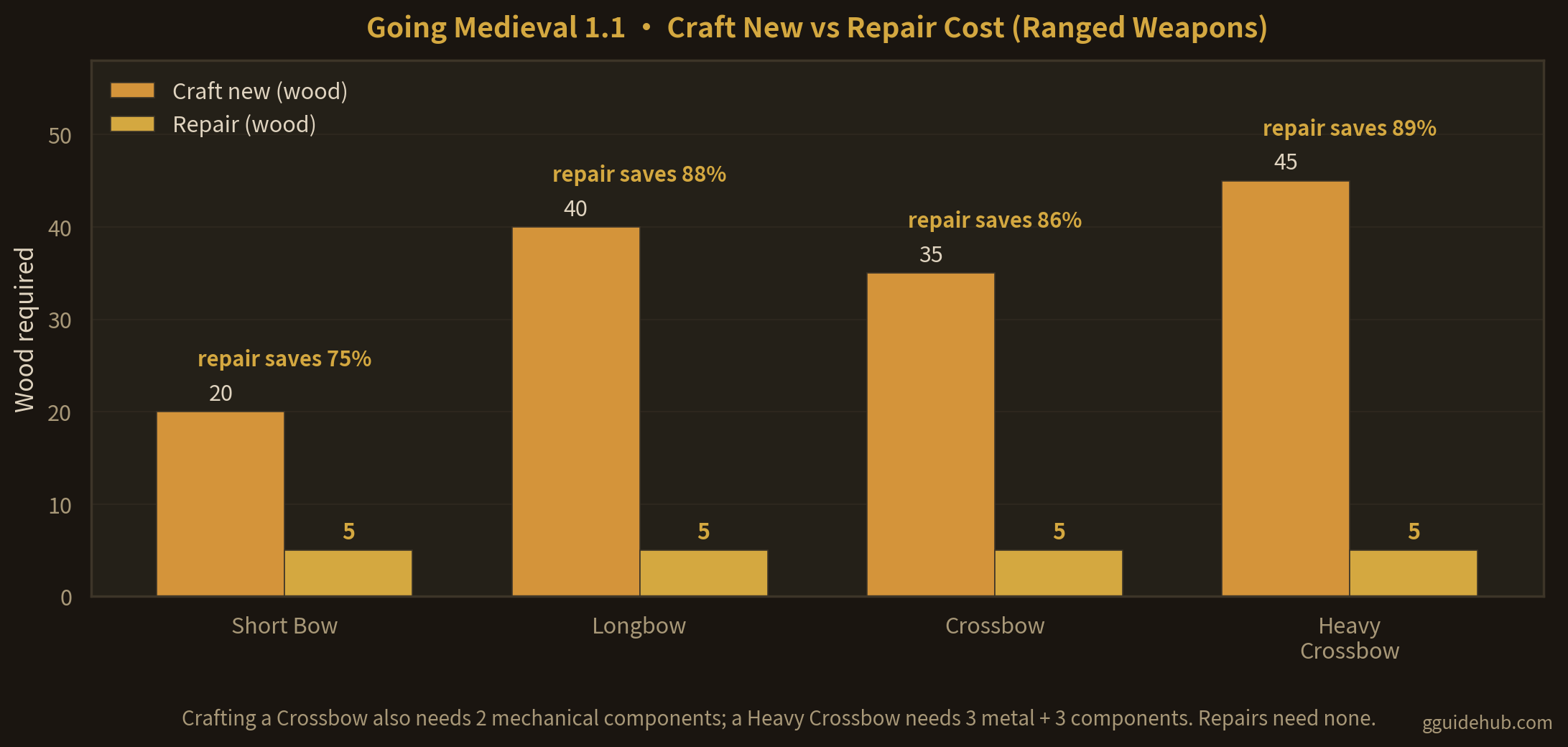
The pattern sharpens as gear gets more advanced. A crossbow's real bottleneck is its 2 mechanical components; a heavy crossbow burns 3 metal and 3 components on top of the wood. Repairing costs none of those — just 5 base material — so every repair of a component-based item effectively refunds its rare ingredients. For metal weapons and armor the logic is identical: recrafting means fresh ingots from the smelting chain, while a repair at the forge spends 5 metal. The one thing repairs never restore is quality, which brings us to the real decision framework.
Quality Cut-Off Rule: Repair Good quality and better without thinking — the material savings are enormous and a high-quality replacement roll is never guaranteed. Think twice about repairing Flimsy gear: a fresh craft costs more materials but rolls a new quality outcome, so for bottom-tier items, replacement doubles as a quality lottery ticket. Exception: if the Flimsy item is made from something scarce (early mechanical components, your first steel), repair it anyway.
Setting Up Repair Orders
Repair orders live in the station's production panel and support the same standing-order logic as crafting. Three filters control what gets repaired and with what: the hitpoint threshold (only items worn below this point qualify), the quality filter (which quality tiers are eligible), and the material condition filter (how damaged the raw materials used for repairs may be). Set them once and your crafters maintain the armory in the background.
A standing setup that works for most colonies: threshold at roughly half hitpoints, quality filter set to Good and above, material condition left permissive. Anything worn past the halfway mark and worth keeping flows into the repair queue automatically; cheap Flimsy gear is ignored and left to be replaced. Because repair time scales with missing hitpoints, catching items at half durability is also faster than rescuing them at 5% — and it avoids the awkward moment when a defender's sword shatters mid-raid.
Repair Strategy by Gear Tier
| Gear Tier | Examples | Policy | Reasoning |
|---|---|---|---|
| Starter / Flimsy | Short bows, wooden shields, rough clothes | Replace, don't repair (unless materials are scarce) | Recrafting is cheap and re-rolls quality; repairs only make sense when wood or cloth is tight |
| Mid / Good | Longbows, crossbows, iron weapons, gambesons | Repair at ~50% hitpoints | 5 resources beats 35–45 wood plus components every time; keeps the squad field-ready |
| High / Superior–Flawless | Heavy crossbows, steel weapons, plate armor | Repair early and always | Replacement costs rare materials and a lucky quality roll; a repair restores full durability for 5 metal |
| Raid loot | Captured enemy weapons and armor | Repair only what your colony actually fields | Repairs cost labor as well as materials; merchant-bound loot is better sold worn than fixed |
Two colony-wide habits multiply the system's value. First, consolidate storage: one armory stockpile or rack near the repair stations keeps hauling time short, and settlers swap damaged gear for fresh spares faster when everything lives in one room — see our storage optimization guide. Second, protect your repair-capable crafters' time: repairs compete with crafting, smelting, and tailoring in the same skill pools, so schedule them through work priorities rather than letting repair orders bury new production. The small XP trickle from repair jobs also makes them decent low-risk training for apprentice crafters between bigger projects.
Frequently Asked Questions
How do you repair items in Going Medieval?
Since the Quality of Life update (1.1.7, July 2026), damaged equipment is repaired at production stations matched to its material: wood-based gear at the Woodwork Bench or Bowyer's Bench, clothing at the Sewing Station, metal weapons and armor at the Blacksmith's Forge, and anything at the Armourer's Table. Queue a repair order like any other production job, and a settler with the right skill will restore the item's hitpoints for 5 units of its base material.
How much does repairing cost in Going Medieval?
A flat 5 resources of the item's base material — 5 wood for a bow, 5 metal for a steel weapon, 5 cloth for a garment. That is a fraction of crafting cost: a Longbow needs 40 wood to craft but only 5 wood to repair (87.5% saved), and repairs never consume mechanical components or other secondary materials. Repair time scales with the worker's skill and the hitpoints missing, and the job grants a small amount of XP.
Does repairing change item quality in Going Medieval?
No. Repairing restores hitpoints but never touches the quality tier — a Flimsy sword stays Flimsy, a Flawless stays Flawless. Repair is ideal for maintaining high-quality gear you could not guarantee recrafting; for low-quality items, a fresh craft doubles as a new roll at a better tier, which is why most colonies replace Flimsy gear and repair Good-or-better gear.
Which station should I use for repairs in Going Medieval?
Prefer the specialist stations — Woodwork Bench or Bowyer's Bench for wooden equipment, Sewing Station for apparel, Blacksmith's Forge for metal gear — because they sit inside your existing production lines with the right workers assigned. The Armourer's Table is the universal option that accepts every repair type, which makes it the best single-station answer for smaller colonies that do not want repair orders scattered across four buildings.
Can you automate repairs in Going Medieval?
Yes. Repair orders support standing filters: set the hitpoint threshold that qualifies an item for repair, the quality tiers you will bother fixing, and how worn the repair materials may be. A proven default is Good quality and above at roughly half hitpoints — settlers then keep the armory topped up on their own, without wasting labor on throwaway Flimsy gear or waiting until items are about to break.
Related Guides
- Quality of Life Update — every change in version 1.1 explained
- Weapon Durability Guide — degradation and breakage mechanics
- Archer vs Crossbow — crafting costs behind the repair math
- Armor Layering Guide — keep your best sets worth repairing
- Best Workshop Layout — station placement that shortens repair trips
- Work Priorities Setup — balance repairs against new production
Last updated: July 19, 2026. Reflects the repair system as introduced in Going Medieval version 1.1.7 (Quality of Life update). Game mechanics may change with future updates.