Going Medieval Quality of Life Update: Every New Feature Explained
On July 9, 2026, Going Medieval received its first major update since the 1.0 launch — the Quality of Life update (version 1.1.7), live on Steam, Epic Games Store, and GOG. This is not a cosmetic patch. It reworks how you build (structure replacing and Plan Mode), how your settlers feel (a full mood, merry, and rebellious-state rebalance driven by perks), how raids end (knockouts and looting instead of colony wipes), and how your gear survives (a real repair system). Two hotfixes followed — 1.1.9 on July 10 and 1.1.11 on July 16 — cleaning up crashes and replace-tool edge cases. This guide walks through every verified change, the exact before/after numbers, and the strategic implications for both new and established colonies.
The Update at a Glance
Eight systems changed meaningfully in 1.1.7. The table below summarizes what each one does and why it matters; the sections after it go deeper on the numbers and the strategies that follow from them.
| Feature | What It Does | Why It Matters |
|---|---|---|
| Replace Structure | Swap existing walls, floors, stairs, beams, windows, doors, ladders, gates, pen fences, and merlons for a different material or type in one action | Upgrading a timber fort to stone no longer means demolishing it — stability is preserved and the old piece refunds some resources |
| Plan Mode | Places blueprints as forbidden so settlers ignore them until you allow construction | Design an entire base expansion up front, review it, then release it for building in one pass |
| Mood & state rebalance | Faster mood movement, harsher early expectations, 6-hour typed rebellious states, 24-hour merry states with perk bonuses | Early-game mood management is now a real survival layer; happy settlers actively boost production |
| Perk chemistry & affection | Perks now like or dislike other perks, radiate area effects, and drive social fights or friendships | Squad composition matters socially, not just for skills — some settlers will simply never get along |
| Item repair | Production stations restore equipment hitpoints for 5 resources of the base material | High-quality weapons and armor become maintainable assets instead of consumables |
| Combat refinement | Raiders knock out rather than kill in small colonies; defeated colonies lose loot, not lives; walls take less damage from non-siege attacks | Early colonies survive defeats; war chests and walled-off stockpiles protect your best goods |
| Animal control & colors | Sleep/idle location preferences, animal beds, pet burials and pyres, butcher filters, coat colors with rarity and simple genetics | Pets stay out of the butcher queue, livestock sleeps where you want, and rare colors (like albino) sell for more |
| Stability visualizer | Shows numeric stability values around the cursor while placing blueprints | Roof spans and overhangs stop being guesswork — you see support values before committing materials |
Replace Structure & Plan Mode: Building Without Demolition
Replace Structure is the community's most-requested feature, and it changes renovation economics completely. Select a built piece — a wooden wall, a thatch roof section, a door — and a Replace Structure option appears in the bottom-right corner with every valid replacement. Swapping overwrites the old piece in place: the new construction keeps the existing support situation, so roofs do not collapse mid-upgrade, and the old piece drops part of its materials for your haulers to reclaim. Replacements that need materials you lack are shown as unavailable. You can also select many structures at once and replace them in bulk — an entire wooden palisade becomes limestone in one order.
Plan Mode solves the other half of the building workflow: settlers rushing to construct half-designed layouts. Any construction can now be placed in Plan Mode, which marks the blueprint as forbidden. Builders ignore it. You can hide forbidden blueprints from view with the toggle in the upper-left corner, keep designing, and when the layout is right, sweep the Allow tool across the plan to release it for construction. Combined with the new stability visualizer — which prints actual stability numbers around your cursor as you place pieces — you can now plan an ambitious multi-storey hall, verify every span, and only then commit your settlers.
Renovation Math: Before 1.1, upgrading a wall ring meant deconstructing it (losing time and part of the materials), risking collapsed roofs, and rebuilding from scratch. Now a bulk replace order handles the whole ring, keeps stability intact, and your old walls partially refund themselves. Pair this with our wall upgrade guide and renovation guide for the full material progression.
Mood, Merry & Rebellious: The New Numbers
The settler mood system received its deepest rebalance since release. The direction is clear: the early game is harsher, mood swings are faster, and states on both ends of the spectrum now do things instead of being passive timers. Rebellious settlers no longer just idle for 18 hours — they flip into typed meltdowns (Eat Binge, Insult Spree, Solitary, Drink and Entertainment, Fist Fight, Feral, and more) chosen from their perks, each with different behavior and collateral damage, but the episode ends after 6 hours. Merry settlers stay merry for a full day and can trigger positive perk effects — a Gourmet cook upgrading a simple meal into a lavish one, a GreenThumb farmer sowing faster and harvesting more, a Winsome settler improving trade deals and social outcomes.
| Modifier | Before 1.1 | After 1.1 |
|---|---|---|
| Rebellious state duration | 18 h | 6 h |
| Merry state duration | 12 h | 24 h |
| Mood change speed | 2 points / hour | 8 points / hour |
| Rebel activation threshold | below 15% mood | below 20% mood |
| Starting comfort stat | ~50% | ~10% |
| Starting entertainment & religious satisfaction | ~75% | ~50% |
| Expectation — uncomfortable | -2 | -6 |
| Expectation — very uncomfortable | -4 | -10 |
| Expectation — initial optimism | +25 | +15 |
| Ate a nice meal | +4 | +3 |
| Packaged food mood bonus | +4 | +0 (removed) |
| Food & sleep mood modifier duration | ~8 h | ~16 h |
| Slept on ground | -5 | -10 |
| Slept outside | -7 | -12 |
| Religious activities deprived | -8 | -12 |
| Deprived of entertainment | -8 | -12 |
| Together we are strong | +16 | +8 |
| Carcass aesthetic impact | -10 | -50 |
| Bones aesthetic impact | -30 | -45 |
| Dung aesthetic impact | -10 | -20 |
Three practical consequences follow. First, bedrooms and floors matter from day one: with comfort starting near 10% and sleeping on the ground now costing -10 mood, an unpainted barracks can push a new settler toward the 20% rebel threshold within days — but mood modifiers from food and sleep also persist for ~16 hours, so one good meal and a real bed carry most of a day. Second, packaged survival rations no longer prop up mood — the +4 bonus is gone, so proper meals are the only food-based mood lever. Third, corpse and refuse hygiene is now a mood system, not a cosmetic one: a carcass rotting in your great hall hits nearby settlers for -50. For the underlying mechanics, see our settler mood system guide and mood management guide.
Perks now drive the social graph. Each settler's Social tab shows relationship history, what is influencing it, and how far a friendship or rivalry can go — and perk pairs actively like or dislike each other. Iron Stomach settlers get along with Callous and Cannibal types but clash with Gourmet, Dainty, Precious, and Austere settlers; Contemplative settlers grind against Outgoing ones; Infirm settlers warm to Benevolent caretakers. Some perks radiate area effects: Industrious settlers lift the mood of people working near them, while wounded, moribund settlers now emit a wound odor that drags neighbors down. When relations sour far enough, social fights can erupt — though a later refinement stops brawls between settlers with strongly positive affection. Our perks guide and relationships system guide cover the underlying systems.
Combat Refinement: Knockouts, Looting, and War Chests
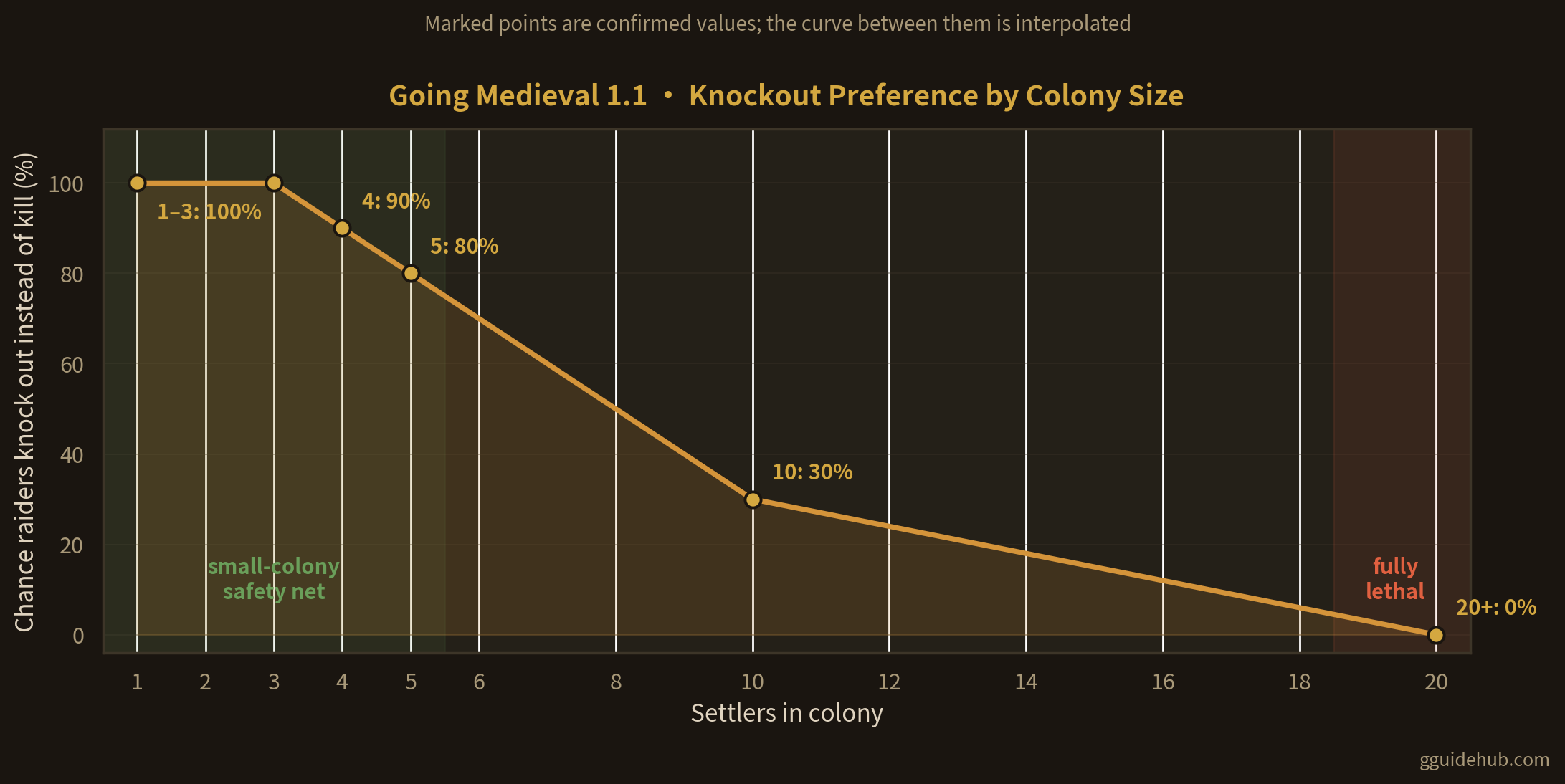
Raid outcomes were rebalanced around one idea: a defeated colony should suffer a setback, not an extinction event. Raiders now prefer to knock settlers unconscious rather than kill them, with the knockout preference scaled against your population — a three-person hermitage is effectively unkillable, while a 20-person fortress faces fully lethal raids again. Enemies attacking without siege weapons also deal reduced damage to structures, so defeated walls are cheaper to rebuild.
| Settlers in Colony | Chance Raiders Knock Out (Instead of Kill) |
|---|---|
| 1–3 | 100% |
| 4 | 90% |
| 5 | 80% |
| 10 | 30% |
| 20+ | 0% |
Values between these anchor points are interpolated by the game — five settlers sit at 80%, ten at 30%, and the curve slides smoothly between them.
When you do lose a raid, the punishment is now economic. Victorious raiders grab some of your resources — or the specific settler they came for in runaway events — and leave. Two exemptions define your defensive storage strategy: anything inside war chests is never claimed, and anything walled off beyond the raiders' reach is never claimed. While raiders are walking off the map after a victory, drafting is temporarily disabled, so there is no dishonorable parting shot in either direction. The meta shifts accordingly: keep your most valuable compact goods (silver, jewelry, rare components) in war chests, and treat your deepest stockpile room as a vault. For the defensive side of the equation, see our raid defense strategy and killbox design guide.
New-Colony Safety Net: Under roughly 5 settlers, a lost fight means knocked-out settlers, stolen goods, and a rebuilding bill — not a save-ending massacre. This makes risky openings (aggressive expansion, early caravans, harder scenarios) far more viable. By the time you pass 20 settlers the training wheels come fully off, so scale your defenses with your population.
Animals: Control, Colors, and Last Rites
Livestock management grows up in 1.1. From the Overview panel you can now set where each animal sleeps — in its owner's quarters, inside any building, outside, or anywhere — and where it idles. New craftable animal beds act as designated sleeping spots. The long-running annoyance of pets being dragged to the butcher table is solved two ways: production buildings that use animal carcasses now have a species filter, and dead pets can be buried in graves or sent off on a pyre (the pyre accepts cats and dogs by default, editable if your colony has darker customs). Settlers will also autonomously pet animals for a small mood boost, and you can order it via right-click prioritization.
Every animal species now comes in multiple coat colors, shown in tooltips and trade windows. Colors have rarity — orange female cats are hard to find, albino anything is the rarest bracket — and rarity nudges trade prices upward. A light genetics system groups colors into hereditary brackets (all tortoiseshell cats share one), so breeding pairs pass their palette tendencies to offspring. Animals already in your saves are assigned a random color when you first load them in 1.1. For husbandry fundamentals, see our animal husbandry guide.
Hotfixes 1.1.9 and 1.1.11
Two patches landed within a week of the update. Patch 1.1.9 (July 10) shortened enter/exit loading on secondary maps for very large settlements, fixed a tutorial soft-lock where required resources could fail to spawn, and cleaned up crashes and visual glitches. Patch 1.1.11 (July 16) focused on the new replace tool: gates no longer shift position when replaced, walls replaced with windows or doors keep the correct rotation, forbidden blueprints no longer turn invisible after the Forbid/Allow tool passes over them, and right-click prioritization works on windows again. It also fixed settlers idly sitting in water or on the ghosts of destroyed chairs, mining reachability quirks around water, stockpiles randomly turning forbidden, and a bug where ranged enemies could fire several projectiles at once like a shotgun.
What to Do First After Updating
Whether you are mid-save or starting fresh, this order of operations extracts the most value from 1.1 in your first in-game days:
| Priority | Action | Payoff |
|---|---|---|
| 1 | Move compact valuables into war chests and wall off your deepest stockpile | A lost raid now costs loot — make sure there is nothing worth stealing within reach |
| 2 | Set butcher-table species filters and pet sleep preferences; place animal beds | Pets stop appearing in the meat queue; barns and pastures stay organized |
| 3 | Queue repair orders for your best weapons and armor at the right stations | High-quality gear returns to full hitpoints for 5 base resources instead of a full recraft |
| 4 | Bulk-replace outer wooden walls with stone using Replace Structure | Perimeter upgrades without demolition, collapse risk, or lost stability |
| 5 | Audit bedrooms and meal quality — comfort starts low and ground-sleeping now costs -10 mood | Keeps settlers clear of the 20% rebel threshold as mood moves 4× faster |
| 6 | Check the Social tab for perk clashes before pairing workers in tight workshops | Avoids Insult Sprees and fist fights; stacks soothing-presence perks where people gather |
| 7 | Turn on the stability visualizer for your next big roof or overhang project | Exact support numbers replace trial-and-error collapses |
Frequently Asked Questions
What is the Going Medieval Quality of Life update?
The first major post-1.0 update, released July 9, 2026 as version 1.1.7 on Steam, Epic Games Store, and GOG. Its headline features are structure replacing, Plan Mode, a perk-driven mood and social overhaul, item repairing, animal sleep controls with coat-color genetics, a stability visualizer, and combat changes that favor knockouts over kills in small colonies. Hotfixes 1.1.9 (July 10) and 1.1.11 (July 16) followed with crash fixes and replace-tool corrections.
Do raiders still kill settlers after the 1.1 update?
Far less often in the early game. Raiders now prefer knockouts scaled by population: 100% knockout chance at 1–3 settlers, 90% at 4, 80% at 5, about 30% at 10, and 0% at 20 or more. Losing a raid means losing resources — or a pursued settler in runaway events — but war chest contents and anything walled off beyond reach are never taken, and drafting is disabled while victorious raiders leave the map.
How does Plan Mode work in Going Medieval 1.1?
When placing any construction you can opt into Plan Mode, which marks the blueprint as forbidden so settlers ignore it. Lay out an entire expansion while builders carry on with existing work, hide the ghosted blueprints with the upper-left visibility toggle, then sweep the Allow tool across the plan to release it for construction. It pairs naturally with the new stability visualizer for checking spans before committing materials.
What did the 1.1 mood rebalance change?
Mood moves four times faster (8 points per hour, up from 2), colonies start with comfort around 10% and entertainment/religious satisfaction around 50%, and early expectations hit harder (uncomfortable -6, very uncomfortable -10). Rebellious states trigger below 20% mood but end after 6 hours and take perk-specific forms like Eat Binge or Fist Fight. Merry states last 24 hours and can fire positive perk effects. Food and sleep modifiers persist about 16 hours, while sleeping on the ground now costs -10 and carcasses in living spaces cost -50.
Can I repair weapons and armor in Going Medieval now?
Yes. Wood-based gear repairs at the Woodwork Bench or Bowyer's Bench, clothing at the Sewing Station, metal items at the Blacksmith's Forge, and the Armourer's Table handles all categories. Repairs cost 5 resources of the item's base material, restore hitpoints without changing quality, scale in time with settler skill and damage taken, and grant a little XP. Full costs and station setup are in our item repair guide.
Related Guides
- Item Repair Guide — station setup, costs, and repair-vs-replace math
- Settler Mood System — thresholds and modifiers in detail
- Mood Management — keeping colonies clear of rebel states
- Raid Defense Strategy — layered defenses for every raid type
- Wall Upgrade Guide — put Replace Structure to work
- Animal Husbandry — breeding, filters, and livestock logistics
Last updated: July 19, 2026. Covers Going Medieval version 1.1.7 (Quality of Life update) with hotfixes 1.1.9 and 1.1.11. Game mechanics may change with future updates.