Going Medieval Best Workshop Layout: Room Bonuses and Floor Plans
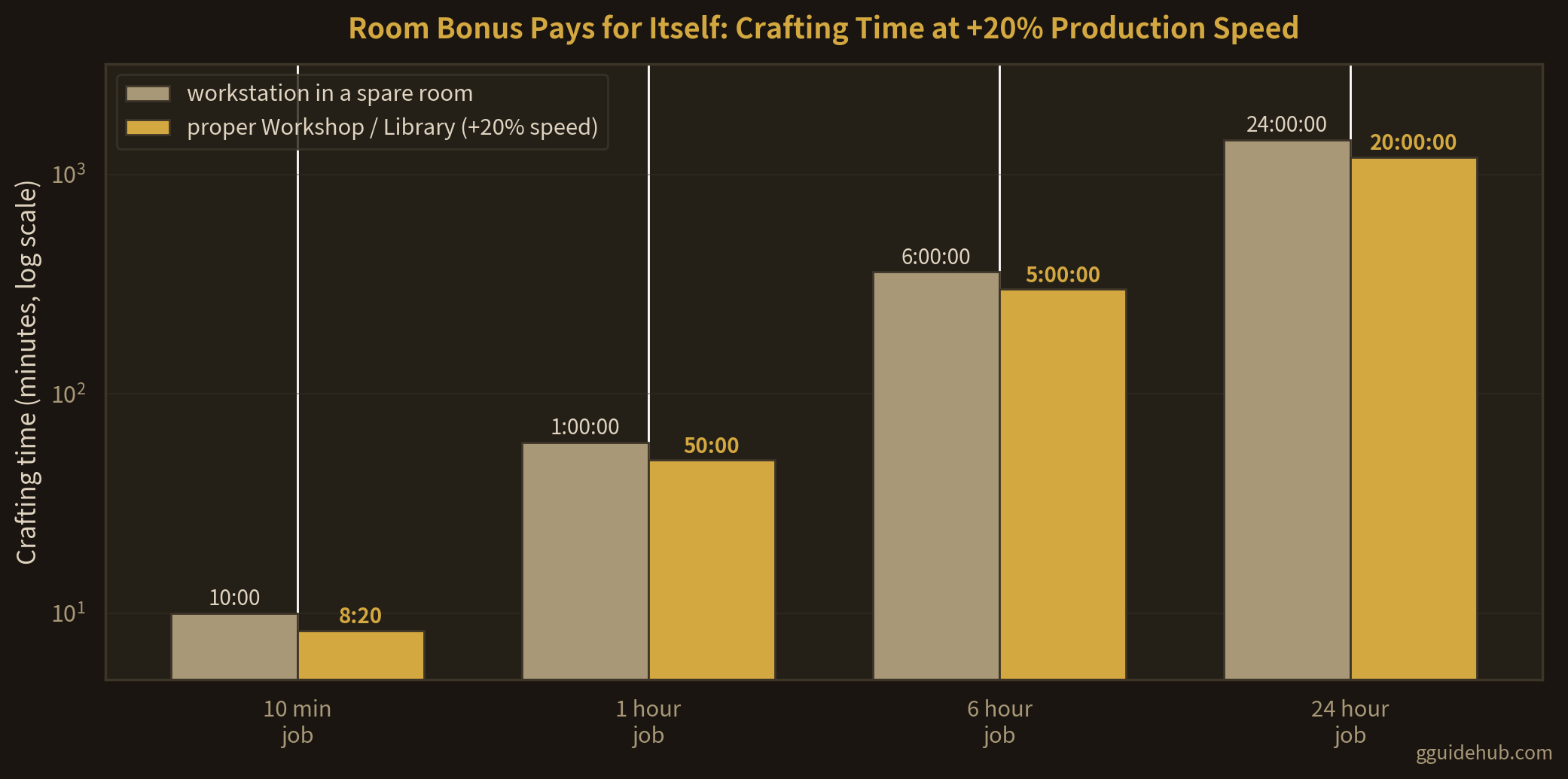
Most colonies build their first crafting stations wherever there is floor space — a smithy in the hallway, a sewing kit in the barracks, a research desk in the rain. Every one of those stations is running slower than it should. Going Medieval recognizes proper room types, and a correctly built Workshop gives every workstation inside it +20% production speed, while a Library does the same for research writing and a Kitchen for cooking. That bonus costs you two wall shelves and a roof. This guide covers the exact room requirements, the station list, and a floor plan that puts the whole production block together without traffic jams.
The Room Bonuses: Exact Requirements
A room in Going Medieval starts as a "spare room" — four walls, a door, and a roof — and only becomes a functional room when the right furniture goes in. The three production rooms and their exact requirements:
| Room Type | Required Furniture | Bonus | Disqualified By |
|---|---|---|---|
| Workshop | 1 crafting workstation + 2 Wall Tool Shelves | +20% production speed at all stations inside | Shrines, entertainment structures |
| Library | 1 Research Table (any tier) + 2 Bookshelves / Wall Bookshelves | +20% speed for writing books | Shrines, entertainment, other workstations |
| Kitchen | 1 Stove + 2 Wall Pottery Shelves + 1 Butchering Table | Faster production at stoves and butchering tables | Shrines, entertainment structures |
Six stations qualify a room as a Workshop: the Armourer's Table, Bowyer's Table, Blacksmith's Forge, Woodwork Bench, Stonemason's Bench, and Sewing Station. Any one of them plus two Wall Tool Shelves flips the room type, and once flipped,every station in the room crafts faster — so the efficient move is one shared workshop hall rather than six tiny sheds. Note that the Library is stricter: other workstations disqualify it, so the research desk always gets its own room.
Which Stations Belong in the Workshop Hall
Group stations by the materials they eat, because hauling time — not crafting time — is what actually bottlenecks a mid-game colony. A smith standing idle while a hauler walks forty tiles for iron ingots loses more than any room bonus can recover.
| Cluster | Stations | Stockpile Within ~5 Tiles | Notes |
|---|---|---|---|
| Metalworking | Blacksmith's Forge, Armourer's Table, Smelting Furnace | Iron nuggets, ingots, coal | Smelter beside the forge keeps fuel trips short |
| Woodworking | Woodwork Bench, Bowyer's Table | Wood, sticks | Near the treeline early; near the wood stockpile later |
| Masonry | Stonemason's Bench, Kiln | Limestone, clay, bricks | Next to the mine entrance — bricks are heavy |
| Tailoring | Sewing Station | Linen, wool, leather | Pair with the clothing shelf in the barracks wing |
| Research (own room) | Research Tables, Apothecary Bench | Books, herbs | Library rules exclude other workstations |
Stockpile discipline: a small dedicated stockpile (5–10 tiles, filtered to one input) next to each cluster beats one giant warehouse across the map. Delete the general stockpile zone for those materials so haulers stop double-handling. See stockpile optimization for the full zoning method and production chain optimization for station-to-station throughput.
Floor Plan: A Compact Production Block
The pattern that works: one rectangular Workshop hall holding two clusters at opposite ends with filtered stockpiles along the shared wall, a separate Library through its own door (it cannot share space with workstations), and the Kitchen across the corridor near the food cellar. Doors on the corridor side only — every exterior doorway is heat loss in winter and a breach point in a raid.
Layout Rules That Survive Contact With the Game
- Roof and enclose everything. A single missing roof tile or wall gap turns your Workshop back into a spare room and silently deletes the +20% bonus. Use the room overlay to confirm the designation after every raid or renovation.
- Wall shelves, not floor shelves. The Workshop needs two Wall Tool Shelves; the Library needs two Wall Bookshelves or Bookshelves. Regular storage shelves do not flip the room type.
- Keep shrines and entertainment out. Both disqualify the Workshop, Kitchen, and Library. Give the chapel and the gaming tables their own rooms — which they need anyway for their own mood bonuses (see room quality system).
- Heat the hall, not the stations. A brazier in the corner keeps workers' hands warm in winter; workbenches themselves do not need heat. Workshops also benefit from clay walls' 0.90 insulation — material values in building material tiers.
- Put the smelter and kiln at the edge. Fuel-hungry stations belong beside the mine entrance or wood stockpile so haulers feed them in a few steps, and their output stockpile feeds the forge next door.
Finally, scale by headcount, not by blueprint. One of each station is enough until you have dedicated specialists; a second forge before you have a second smith is a waste of bricks and floor tiles. When you do expand, extend the hall lengthwise and mirror the stockpile wall — the layout above doubles cleanly. Job assignments that keep the right settler at the right bench are covered in settler job assignment and work priorities setup.
Frequently Asked Questions
How do you get the +20% production speed bonus in Going Medieval?
Enclose your crafting stations in a room the game recognizes as a Workshop: a fully enclosed, roofed room with at least one crafting workstation (Armourer's Table, Bowyer's Table, Blacksmith's Forge, Woodwork Bench, Stonemason's Bench, or Sewing Station) and two Wall Tool Shelves. Every station inside then produces 20% faster — a one-hour job finishes in fifty minutes. Shrines and entertainment structures disqualify the room.
Does the research table get a speed bonus in Going Medieval?
Yes, but in a Library, not a Workshop: an enclosed room with one research table of any tier plus two bookshelves or wall bookshelves gives +20% speed for writing books (Chronicles, Handbooks, Theses). Libraries exclude other workstations, so the research desk always gets its own room next to the workshop block.
Can I put multiple workstations in one Workshop room in Going Medieval?
Yes — one Workshop can hold as many of the six qualifying stations as you can fit, and every one gets the +20% bonus as long as the room keeps its two Wall Tool Shelves and stays enclosed. The limit is practical: group related stations (smithing, woodworking, tailoring) with a small filtered stockpile a few tiles from each bench so haulers don't create traffic jams.
Should the kitchen be inside the workshop in Going Medieval?
No. The Kitchen is its own room type — one Stove, two Wall Pottery Shelves, one Butchering Table — boosting stoves and butchering tables specifically. Neither room's bonus covers the other's stations. Build them as neighbouring rooms with the food cellar and meal stockpile between them.
Why isn't my Workshop room being recognized in Going Medieval?
Check three things: the room must be fully enclosed with a roof (one missing tile reverts it to a spare room); it needs at least one qualifying workstation and two Wall Tool Shelves specifically — regular shelves don't count; and shrines or entertainment structures inside cancel the designation. Turn on the room overlay to see exactly what the game detects.
Related Guides
- Room Quality System — Impressiveness, mood, and room requirements
- Workshop Efficiency — throughput beyond the room bonus
- Production Chain Optimization — station-to-station flow
- Stockpile Optimization — kill the hauling bottleneck
- Kitchen Design — the food production room
- Building Material Tiers — what to build the hall from
- Research — what the Library unlocks and when
- Base Layout — where the production block sits in the colony
Last updated: July 19, 2026. Game mechanics may change with future updates.