Going Medieval Room Quality System: Impressiveness, Tiers, and Mood
Every room in Going Medieval has a hidden report card. The game scores each enclosed space on three stats — wealth, beauty, and spaciousness — multiplies them together, and stamps the room with an Impressiveness tier from Awful to Palatial. That stamp is not decorative: it scales the mood bonuses settlers get for sleeping, eating, and praying in the room, and mood is the difference between a colony that works and one that breaks. The good news is that the formula is fully known, and its multiplicative shape tells you exactly where to spend your first decorations. This guide gives the real tier thresholds, the multiplier tables, and the upgrade order that raises quality cheapest.
The Eight Impressiveness Tiers
Impressiveness is a single score with eight named tiers. The early tiers come almost free — a floored room with a window clears Modest — while the top tiers demand real wealth and space. The thresholds:
| Tier | Score Threshold | What It Takes in Practice |
|---|---|---|
| Awful | 0 | Dirt floor, no light, no decoration |
| Uninspiring | 10 | A floor and a bed, nothing more |
| Modest | 15 | Floor + window + a little space — the year-one target |
| Good | 65 | Tile floors, wall banners, uncluttered room |
| Superior | 300 | Real furniture, decorations, generous floor space |
| Luxurious | 750 | High-value furnishings across a large room |
| Opulent | 2500 | Endgame wealth on display |
| Palatial | 6000 | The showpiece great hall or noble chamber |
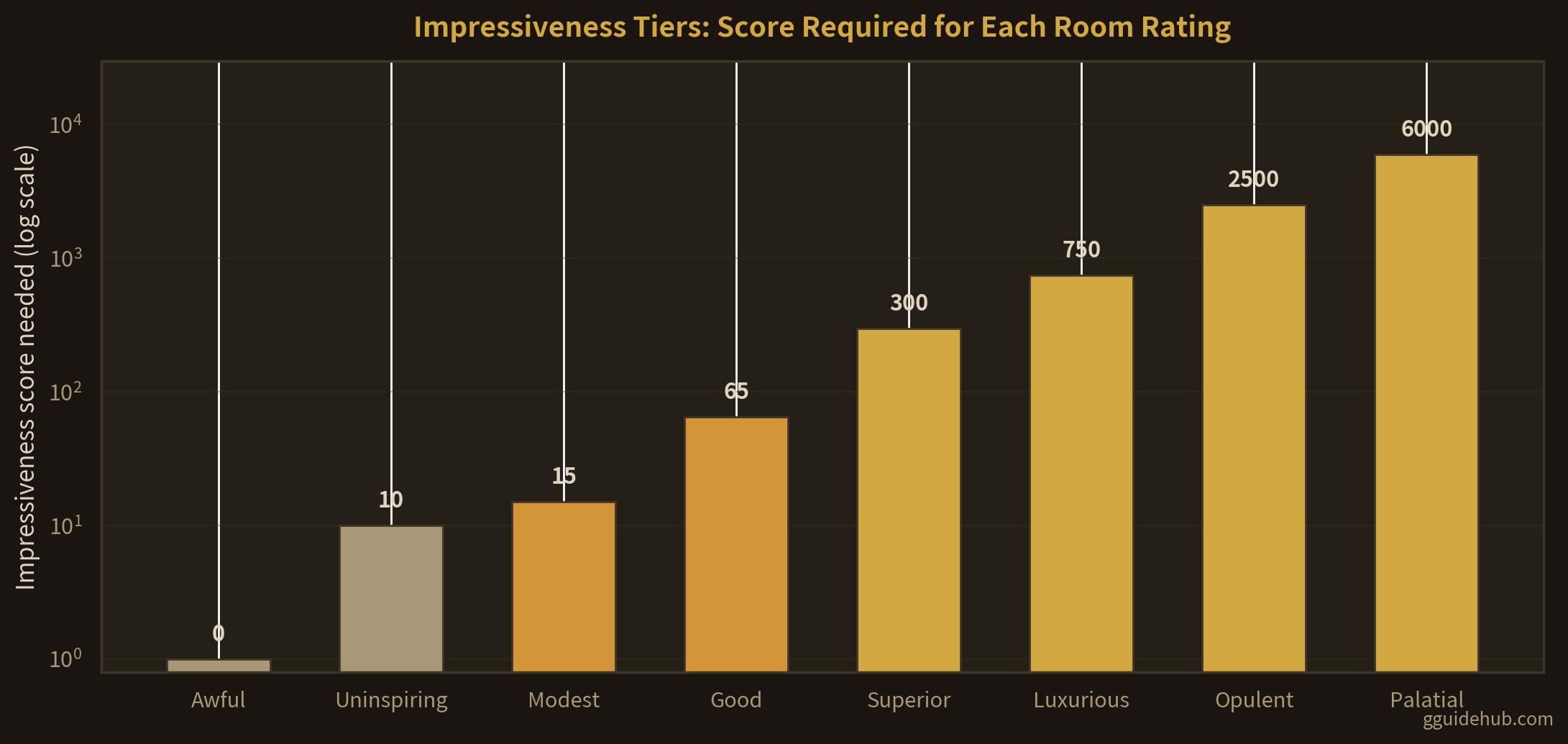
The Formula: Three Multipliers, One Product
The score is a product: beauty multiplier × wealth multiplier × spaciousness multiplier (rounded down). Each multiplier comes from a tiered lookup table, interpolated linearly between breakpoints. The tables:
| Average Aesthetic Value | Beauty Multiplier | Total Wealth | Wealth Multiplier | Free Tiles | Spaciousness Multiplier |
|---|---|---|---|---|---|
| -50 | 0.0 | 0 | 0.0 | 0 | 0.0 |
| -30 | 0.5 | 90 | 2.5 | 16 | 3.0 |
| -20 | 1.0 | 230 | 3.0 | 30 | 3.5 |
| -5 | 3.0 | 500 | 4.0 | 60 | 4.0 |
| 0 | 3.5 | 2,000 | 8.0 | 120 | 7.0 |
| 10 | 4.5 | 4,000 | 16.0 | 200 | 12.0 |
| 20 | 8.0 | 10,000 | 32.0 | — | — |
| 30 | 16.0 | — | — | — | — |
| 40 | 32.0 | — | — | — | — |
| 50 | 64.0 | — | — | — | — |
A worked example shows the interpolation in action: a room with 45 spaciousness, 11,000 wealth, and 25 average aesthetic value gets multipliers of 3.75 (spaciousness, interpolated between the 30- and 60-tile rows), 32 (wealth, just past the 10,000 row), and 12 (beauty, halfway between the 20 and 30 rows). Their product is 1,800 — a Luxurious room.
Multiplicative means weakest-link: a zero anywhere zeroes the room. A palace stuffed with treasure but floored in ugly dirt (−50 aesthetic → 0.0 multiplier) scores exactly zero. Always fix the worst stat first — it is almost always beauty, and the fix is usually just a proper floor.
Where Impressiveness Actually Pays: Room Mood Effects
Not every room spends its Impressiveness. Production rooms (Workshop, Library, Kitchen) grant speed bonuses that ignore the tier entirely — the mood payoff lives in the rooms where settlers rest, eat, and pray:
| Room | Mood Effect | Duration | Scales With Impressiveness? |
|---|---|---|---|
| Chamber (private, 1 bed) | Positive modifier for the sleeper — double the Shared Chamber bonus | 16 h | Yes |
| Shared Chamber (2+ beds) | Small positive modifier for each sleeper | 16 h | Yes |
| Great Hall | Positive modifier after each meal eaten there | Per meal | Yes |
| Chapel / Temple (matching religion) | Positive modifier for time spent there | 24 h | Yes |
| Workshop / Library / Kitchen | Production speed bonuses instead of mood | — | No |
Two practical consequences. First, a private chamber is a real mood item, not a luxury: it doubles the sleep modifier of a shared room for 16 hours a day, so your most stressed settlers should get their own rooms first. Second, watch the jealousy perks — settlers with dainty or precious traits take mood penalties when someone else has a nicer room than they do, so upgrade rooms in waves rather than building one showpiece while the rest sleep in squalor. For the mood system as a whole, see settler mood system and mood management.
Raising Room Quality: The Cheap-to-Dear Order
Because the formula multiplies, the efficient path is to lift whichever multiplier is lowest — and for most colonies that follows the same sequence:
| Step | Upgrade | Multiplier Moved | Typical Gain |
|---|---|---|---|
| 1 | Lay wood or tile floor over dirt | Beauty: negative → positive | Saves the room from a 0–1.0 beauty multiplier |
| 2 | Add a window and clear clutter for free tiles | Spaciousness toward 3.0–3.5 (16–30 tiles) | ~3× over a cramped room |
| 3 | Wall banners, trophy racks, better bed | Beauty + wealth together | Pushes Modest rooms to Good (65) |
| 4 | Quality furniture, decorative racks, rugs of value | Wealth toward 500–2,000 (×4–8) | Good to Superior (300) territory |
Floors do double duty: they raise beauty for Impressiveness and add thermal insulation — a tile floor insulates at 0.8 versus 0.75 for wood — so one build job improves both the room's comfort and its score. Material values are in building material tiers, and the rooms worth building first (Workshop +20% speed, Great Hall, chambers) are detailed in best workshop layout and bedroom layout.
Frequently Asked Questions
How does room quality work in Going Medieval?
Every enclosed room has an Impressiveness score computed from three stats — total wealth, average aesthetic value, and spaciousness (free tiles). Each stat converts to a multiplier via tiered tables, and the three multiply together into a score mapping to eight tiers from Awful (0) through Modest (15), Good (65), Superior (300), Luxurious (750) up to Palatial (6000). Higher-tier bedrooms, dining halls, and chapels grant stronger mood bonuses.
What are the Impressiveness tiers in Going Medieval?
Eight tiers: Awful at 0, Uninspiring at 10, Modest at 15, Good at 65, Superior at 300, Luxurious at 750, Opulent at 2500, and Palatial at 6000. Because the score is a product of three multipliers, neglecting any single stat caps the whole room — a wealthy but cramped room with ugly floors stalls far below its potential.
Does a private bedroom matter in Going Medieval?
Yes. A settler sleeping in a private Chamber (exactly one bed) gets a positive mood modifier for 16 hours at double the strength of a Shared Chamber's bonus, scaled by Impressiveness. Shared Chambers are the efficient early-game choice — a 15-tile shared room with hay sleeping spots and a window already counts as Modest — but upgrade stressed settlers to private chambers as wealth allows, starting with dainty or precious settlers who get jealous of nicer rooms.
What is the cheapest way to raise room quality in Going Medieval?
Raise the weakest of the three multipliers first, because the score is a product. The usual cheapest wins: lay a real floor (tile or wood instead of dirt) to lift average beauty, add a window and wall decorations (banners, trophy racks) for cheap wealth and beauty, and remove junk to free up tiles. A room with 30 free tiles already earns a 3.5 spaciousness multiplier, and pushing average aesthetic value from 20 to 30 doubles the beauty multiplier from 8 to 16.
Do workshops and kitchens use Impressiveness in Going Medieval?
No — production rooms care about room type, not tier. A Workshop grants +20% production speed whether it is Awful or Palatial, as long as it has the required workstation and two wall tool shelves. Impressiveness matters where settlers relax: bedrooms (16-hour sleep modifiers), the great hall (a positive modifier after each meal), and chapels (24-hour modifiers). Decorate those first.
Related Guides
- Best Workshop Layout — room type bonuses and floor plans
- Bedroom Layout — private chambers that actually raise mood
- Great Hall — the dining room mood engine
- Settler Mood System — every modifier that moves the needle
- Mood Management Guide — keeping the colony stable
- Building Material Tiers — floors that raise beauty and insulation
- Room Design — shapes and sizes that work
- Happiness Guide — the long game on settler morale
Last updated: July 19, 2026. Game mechanics may change with future updates.