Going Medieval Specialist Training: Skills, XP, and the Passion Multiplier
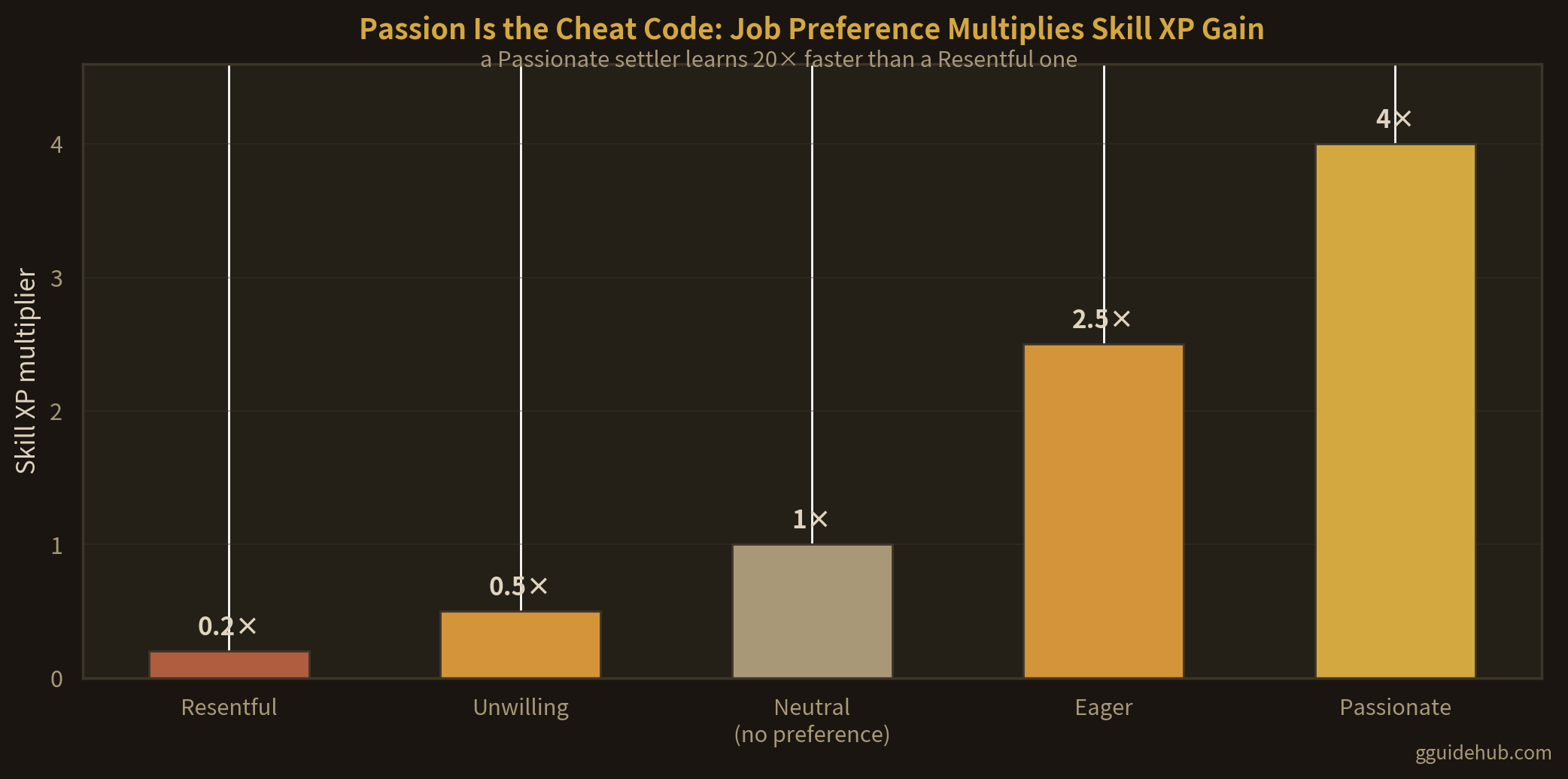
Every settler in Going Medieval is a bundle of fourteen skills, each running from level 0 to 50, and every hour of work is also an hour of training. The catch is that the game's XP math punishes generalists: the first level costs 350 XP, the fiftieth costs 8000, and a settler's attitude toward the work multiplies everything they earn — from a miserable 0.2× for the Resentful to a roaring 4× for the Passionate. Train a settler against their preferences and you pay twenty times the time for the same level. Train with the grain and a single Passionate specialist will out-produce three dabblers. Here is the full system: the skills, the XP curve, and the training setups that work.
The Fourteen Skills and What They Feed
| Skill | What It Governs | Jobs That Train It |
|---|---|---|
| Animal Handling | Taming, feeding, training and hunting animals | Fish, Animal Husbandry |
| Art | Statues, paintings, tapestries | Artist |
| Botany | Sowing, growing, harvesting and gathering plants | Grow, Harvest, Cut Plants |
| Carpentry | Wooden items and bows | Carpentry (woodwork bench, bowyer's table) |
| Construction | Bricks, chiseling rock, overall construction speed | Construct |
| Culinary | Cooking and butchering | Cooking |
| Intellectual | Research speed; brewing spirits and medicinal drugs | Research, Alchemy |
| Marksman | Ranged weapons — bows and crossbows | Hunt, combat, training |
| Medicine | Healing others and self-healing | Tend |
| Melee | Weapon damage; higher levels unlock advanced weapons, dodge, crit | Melee combat, training |
| Mining | Mining and digging | Mine |
| Smithing | Metal weapons and armour; faster ingot production | Smithing |
| Speechcraft | Bargaining, cheering up settlers, turning enemies to allies | Bartering, Gaoler, Bard, Prison Warden |
| Tailoring | Clothing and leather armour | Tailoring |
The XP Curve: 350 to 8000, Cap 50
Two anchor numbers define the whole curve: level 1 costs 350 XP; level 50 costs 8000 XP, with the per-level requirement rising all the way. Everything else is multipliers:
| Factor | Effect on XP Gain | Source |
|---|---|---|
| Level 1 requirement | 350 XP | Game data |
| Level 50 requirement (the cap) | 8000 XP | Game data |
| Job preference: Resentful | 0.2× XP | Game data |
| Job preference: Unwilling | 0.5× XP | Game data |
| Job preference: Eager | 2.5× XP | Game data |
| Job preference: Passionate | 4× XP | Game data |
| Perk: Erudite | +30% XP gain (and +5 Intellectual) | Game data |
| Perk: Dullard | −25% XP gain (and −5 Intellectual, −3 Speechcraft, +10% clumsiness) | Game data |
Building a Specialist: The Working Rules
| Rule | Why It Works |
|---|---|
| Recruit and assign by passion, not by current level | 4× XP closes any level gap in weeks; a level-15 Resentful miner trains at 0.2× forever |
| One profession per settler, protected by the Jobs panel | Every hour on a side job is an hour not training the main skill — blank the rest |
| Keep specialists on the job daily, even in small doses | XP comes from doing the work; a smith who forges one item a day still climbs the curve |
| Use the Train job for combat skills before raids force the issue | Training builds Melee and Marksman safely; higher Melee levels unlock advanced weapons, dodge, crit and precision |
| Protect your low-skill colony from itself | Failed work can destroy output — a low-Botany settler can ruin a harvest outright, so gate delicate jobs behind skill |
| Let Speechcraft specialists work people, not benches | Bartering, gaoler and bard duties train the skill no workshop touches — and better traders pay for themselves |
The priority setup that makes all of this automatic — profession at priority 1, everything harmful blanked — is in work priorities setup. And the mood payoff is real: working a preferred job grants Job Satisfaction (+4 mood for 12 hours), so passion assignments train faster and keep settlers happier — the numbers are in settler mood system.
The math of one great hire: a Passionate (4×) Erudite (+30%) scholar earns XP at roughly 5.2× the neutral rate. Against the 350→8000 XP curve, that settler reaches useful mid-levels before a neutral scholar finishes the early ones — and research is the colony's tech gate. When choosing between recruits, a passion match beats five starting levels.
Frequently Asked Questions
How do settlers level up skills in Going Medieval?
By doing jobs governed by the skill — cooking levels Culinary, mining levels Mining, research levels Intellectual. Skills run 0–50; level 1 costs 350 XP and level 50 costs 8000 XP, with the per-level cost rising throughout. Job preferences multiply all XP earned, from 0.2× (Resentful) to 4× (Passionate).
What is the maximum skill level in Going Medieval?
Level 50 for every skill in the base game. The XP curve runs from 350 XP for level 1 to 8000 XP for level 50 — the top level alone costs more than twenty times the first, so a settler realistically maxes only one or two skills per playthrough.
How much does passion affect skill gain?
Enormously: Resentful 0.2×, Unwilling 0.5×, Eager 2.5×, Passionate 4× XP — a twenty-fold gap between best and worst. Preferences also apply positive or negative mood modifiers when doing the associated work, so passion is a training stat and a mood stat at once.
Which skills should I specialize first?
Follow the survival chain: Botany (food — low skill can ruin harvests), Culinary (better meals with mood bonuses), Construction (all building speed), and Intellectual (the research gate). Melee and Marksman follow as raids scale, and Medicine deserves one dedicated settler from the first winter.
Do perks affect skill training?
Yes. Erudite gives +5 Intellectual and +30% XP gain; Dullard gives −5 Intellectual, −3 Speechcraft, −25% XP gain and +10% clumsiness. Backstories also bundle starting levels with preferences — an Erudite, Passionate scholar is the best research engine available, while a Dullard settler belongs on simple labour.
Related Guides
- Work Priorities Setup — protect specialists with the Jobs panel
- Settler Skills — deeper detail on each skill's unlocks
- Newcomers' Skills — reading recruits before you commit
- Settler Mood System — Job Satisfaction and preference mood effects
- Settler Job Assignment — matching passions to roles
- Maximize Settler Efficiency — schedules that multiply training time
- Perks Guide — Erudite, Dullard, and the rest of the perk table
- Research — where your Intellectual specialist spends those levels
- Settlers — backstories, traits, and starting levels
Last updated: July 19, 2026. Game mechanics may change with future updates.