Going Medieval Enemy Pathfinding, Exploited
Every raid in Going Medieval is two fights: the one your archers have with the raiders, and the one the raider AI has with your floor plan. The second fight is decided before the horn sounds, because the pathfinding rules are deterministic enough to build around. Raiders take the shortest valid path to something they can reach — and you decide what "valid" means with doors, forbidden markers, and corridors. This guide lays out the pathing rules as the community has verified them, the techniques those rules enable (bait doors, funnels, lockdowns), the limits where the AI stops cooperating, and the exploits the 1.0 patch quietly removed. No myths, no magic invincibility tricks — just the mechanics.
The Pathing Rules, Verified
Everything exploitable about raider AI follows from one behaviour: enemies route to a reachable target along the cheapest open route, and they only become demolition crews when no such route exists. The community-tested rules:
| Situation the AI Finds | What Raiders Do | How You Exploit It |
|---|---|---|
| An open path into the base exists | Walk it, even if it is long and trapped | Make your killbox corridor the only open path (bait door) |
| Several open paths exist | Split toward whichever is shortest for each raider | Forbid every door except the bait door when the horn sounds |
| All routes sealed (doors forbidden or walled) | Stop pathing; attack the nearest wall or door in the way | Never fully seal — or seal deliberately and defend the breach point |
| Target unreachable at any cost | Demolition continues until a path opens or the raid ends | Double-wall the segments nearest the usual spawn edges |
| Wild animal aggression event | Animals cannot open doors | Get everyone indoors; archers shoot over the walls |
| Ladder-only entrance | Only polecats among wild animals can use ladders | Ladder access makes animal-proof food stores and pet-free zones |
The Techniques the Rules Enable
None of these are glitches — they are defence designs that fall out of the pathing rules above. The full construction details (funnel angles, trap counts, embrasure placement) are in our killbox design guide; here is what each technique does to the AI and where it fails:
| Technique | AI Rule It Exploits | Execution | Failure Mode |
|---|---|---|---|
| Bait door | Raiders take the shortest valid path | One passable door at the trap corridor's inner end; all other doors forbidden during raids | A side door left passable splits the raid; a blocked bait path flips raiders to demolition |
| Funnel + trap corridor | Valid path is walked regardless of danger | Walls angle all approach routes into one trapped channel | Gaps between funnel walls and terrain let raiders slip around |
| Forbidden-door lockdown | Forbidden doors are not valid paths | Forbid exterior doors to pull settlers inside and control the one open route | Lockdown with no bait at all = raiders start breaking walls instead |
| Door tanking | Demolition targets the structure in the way | A closed door in the corridor mouth buys volley time while raiders break it | Weapons with high building damage shred doors fast — buy seconds, not minutes |
| Indoor lockdown vs. animals | Animals cannot open doors | Everyone inside, archers fire over walls until the event ends | A settler caught outside is defenceless; mind farmers and hunters |
| Ladder-gated storage | Only polecats use ladders among wild animals | Ladder-only access to food stores keeps wildlife out | Most pets can't use ladders either — feed animals elsewhere |
Reality check: two genuine exploits are dead. Since the 1.0 update, raiders used to freeze in place when ordered to attack unfinished or foundation-phase buildings — players laid dummy blueprints as raid-stoppers — and raiders who won a raid used to stand idle in your settlement forever. Both are fixed: the AI now ignores the foundation bait and victorious raiders leave. If an old guide promises a raid that never fights, it's describing a patched bug, not a mechanic.
Why Range Is a Pathfinding Stat
Once raiders commit to your corridor, the only question left is how long they spend inside it under fire — and that is set by engagement range, not by how angry your archers are. Using the verified weapon numbers from our killbox guide: crossbows reach 25m while bows reach 18m, which means crossbowmen open up roughly seven corridor tiles earlier. Over a long funnel that head start is worth entire extra volleys before the first raider reaches a trap:
| Weapon (Good Quality) | Max Range | Attack Duration | Pathfinding Role in the Corridor |
|---|---|---|---|
| Short Bow | 18m | 5.4s | Engages late; only useful on long corridors |
| Longbow | 18m | 5.4s | High volume of fire once raiders close the distance |
| Crossbow | 25m | 9.45s | Opens fire ~7 tiles earlier — punishes the walk-in |
| Heavy Crossbow | 25m | 10.35s | Deletes priority targets while they are still funneling |
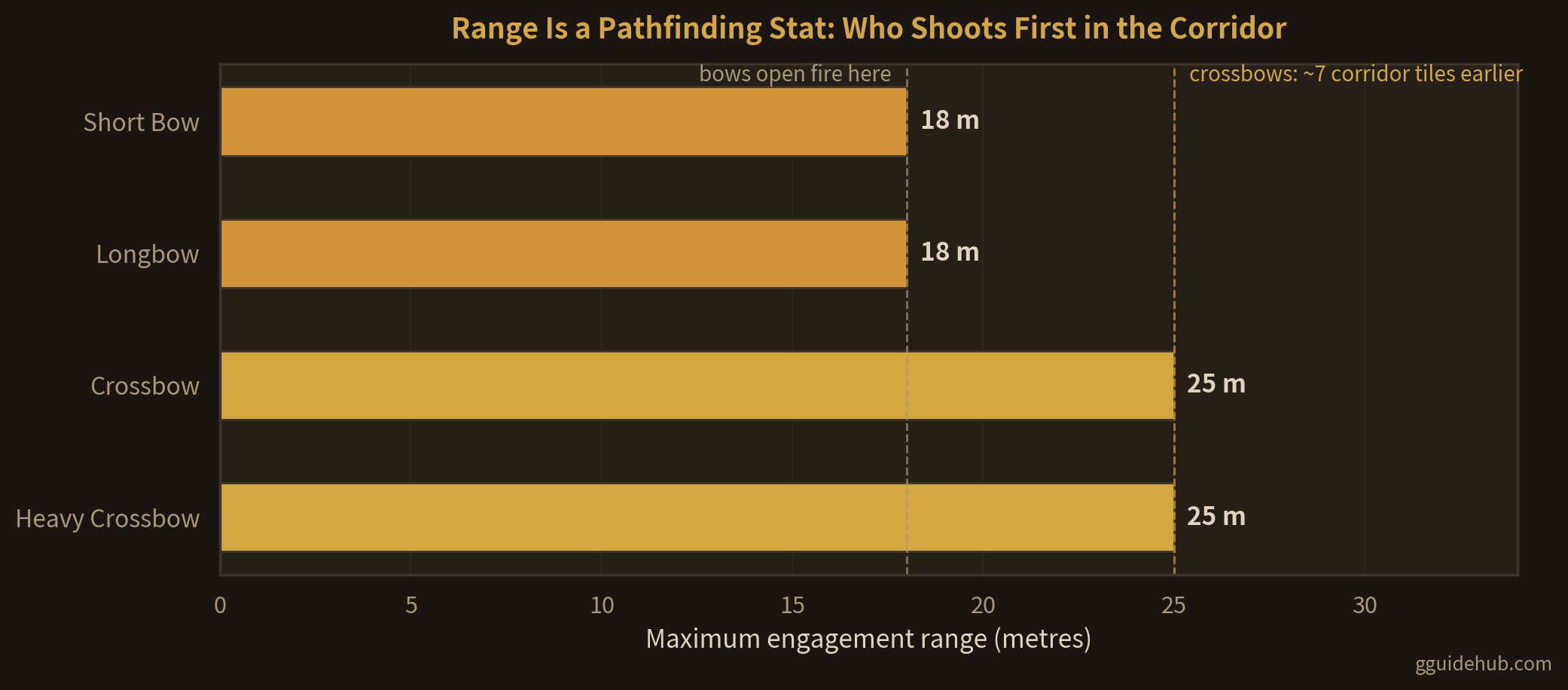
The design read: corridor length should match your weapons' reach. A short corridor wastes crossbows (they reload slowly and want maximum walk-in time), while a long corridor wastes short bows (raiders arrive before the archers contribute). Put the long-range crossbows behind the embrasures, the bows deeper where survivors arrive, and let the pathfinding bring targets to each in turn. Cover and firing positions are covered in the raid defense strategy guide.
One last discipline note: watch the raid before you trust the design. When raiders spawn, trace the route they actually take against the one you intended — spawn edges differ per raid, and a funnel built for the south approach does nothing for a raid arriving from the east. The colonies that beat above-weight raids are the ones that treat the pathing rules as a hypothesis and re-verify them every single horn.
Frequently Asked Questions
How do raiders decide where to go in Going Medieval?
Raiders path toward the easiest reachable target along the shortest valid route. A passable door is walked through; a fully sealed base flips them to demolishing the nearest wall or door in the way. Defence design is the art of controlling which path counts as valid — one bait door into a trap corridor, everything else forbidden.
Will raiders attack my walls and doors in Going Medieval?
Yes, whenever no valid walking path in exists. Weapons carry different building-damage ratings — the game's tooltips grade building damage from low up to severe — so demolition speed depends on what the raiders carry. A sealed base doesn't stop a raid; it moves the fight to a breach point you didn't choose.
What is a bait door in Going Medieval?
A single passable door at the inner end of your killbox corridor. Because raiders take the shortest valid path to a reachable target, the open door makes your trap corridor that path, and the AI commits to it. Every other entrance must be forbidden during the raid or raiders may split toward whichever route is shortest.
Can animals open doors or climb ladders in Going Medieval?
Animals cannot open doors, so getting every settler indoors neutralises most animal aggression events. The polecat is the only wild animal that uses ladders, so a ladder-only entrance animal-proofs a food store. Human raiders are another matter — treat stairs and normal entrances as fully usable by them.
Do the old raider AI exploits still work after Going Medieval 1.0?
No — the 1.0 update fixed both famous ones: raiders no longer freeze when attacking unfinished or foundation-phase buildings, and victorious raiders now leave instead of standing idle forever. The core pathing rules behind bait doors and funnels are untouched, so corridor defence still works exactly as designed.
Related Guides
- Killbox Design — funnels, traps, embrasures, and the bait door in detail
- Raid Defense Strategy — layered defence from horn to mop-up
- Double Wall vs Single Wall — what demolition crews actually cost you
- Door Placement Tips — where doors help and where they hurt
- Chokepoint Guide — single-entrance perimeter design
- Trap Placement — spike trap spacing inside the corridor
- Archer vs Crossbow — the full ranged weapon comparison
Last updated: July 19, 2026. Building-damage grades are the game's own qualitative tooltip categories. Pathing behaviour may shift with updates — re-verify against live raids.